Let's Shake Hands: Free Connection Call 

What is the #1st worst habit for anxiety?
Table of Contents
The #1 worst habit for anxiety is avoidance, which is a form of ignorance. When you dodge people, places, or tasks that make you feel nervous, you get quick relief. However, this habit teaches your brain that the feared thing is truly dangerous. It shrinks your world and makes your anxiety stronger over time.

Here is the continuation with the scientific context and how somatic shaking fits in:
The Scientific Context of Avoidance
Avoidance triggers a well-documented psychological and neurobiological feedback loop known as negative reinforcement amplification.
- The Neurobiology of Avoidance: When you dodge a trigger (a hard conversation, a crowded room, or a stressful task), your body experiences an instant drop in cortisol and adrenaline. This quick relief acts as a neurochemical “reward.” The amygdala—the brain’s threat detection center—misinterprets this relief as proof: “We only survived because we ran away.”
- Interrupted Extinction Learning: In cognitive and behavioral neuroscience, the brain unlearns fear through habituation—staying with the uncomfortable sensation long enough for the nervous system to realize there is no actual danger (extinction learning). Avoidance cuts this natural rewiring short. Through neuroplasticity, avoiding a situation repeatedly reinforces the neural pathways that classify harmless triggers as life-threatening dangers.
What Somatic Shaking Brings to the Table
When avoidance becomes a habit, fear doesn’t just live in your thoughts—it gets stored in the body as chronic fascial tension and autonomic nervous system dysregulation.
- Releasing the Fight-or-Flight Charge: Trying to “think” your way out of anxiety often fails because bottom-up nervous system activation bypasses top-down logic. Dynamic somatic shaking taps into neurogenic tremoring—the innate mammalian mechanism designed to discharge residual adrenaline and reset homeostasis after a stress response.
- Direct Somatosensory Safety: Shaking engages the ventral vagal pathway of the parasympathetic nervous system. The rhythmic physical discharge communicates directly with the brainstem and amgydala in a language they understand: “The body is actively completing the stress cycle. We are safe now.”
- Breaking the Avoidance Loop: By giving your body a physical outlet to release the accumulated sensation of panic, somatic shaking restores your capacity to tolerate discomfort. Instead of dodging the world to find temporary relief, you build the physiological resilience needed to stand your ground, face triggers, and expand your comfort zone.
You can adapt the standard 3-3-3 rule into a Somatic Shaking Reset.
While traditional 3-3-3 relies mostly on top-down mental tracking (distracting the brain with sensory inputs), weaving dynamic movement directly into the third step shifts it into a bottom-up nervous system reset.
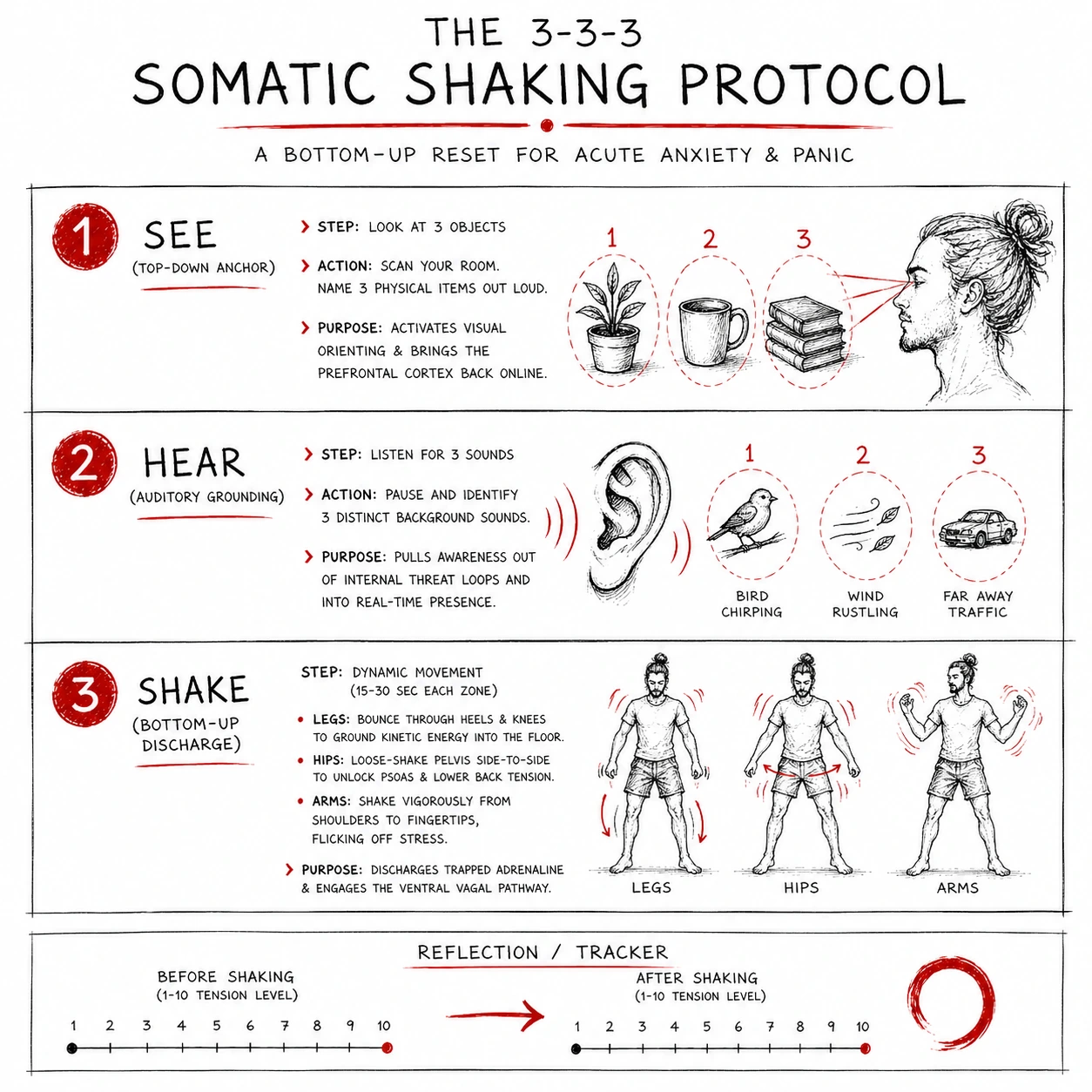
What is the 3-3-3 rule for anxiety?
The 3-3-3 method is a simple grounding technique used to calm acute anxiety or panic. When you feel overwhelmed, you look at three things, listen for three sounds, and move three parts of your body. This shifts your focus away from racing thoughts and back to the present moment.
The 3-3-3 Somatic Shaking Protocol
When panic or acute anxiety strikes, use sensory grounding to anchor your awareness, then use targeted body vibration to discharge the physical adrenaline surge.
Why Adding Shaking Elevates the 3-3-3 Rule
| Standard 3-3-3 Method | 3-3-3 Somatic Shaking Protocol |
| Cognitive Distraction: Relies on top-down focus to pull you out of anxiety thoughts. | Full Neurobiological Completion: Combines cognitive orientation with direct physical discharge. |
| Mental Anchor: Calms the mind while the body may still hold residual adrenaline. | Fascial & Vagal Reset: Vibrates the tissue, stimulating the ventral vagus nerve to lower heart rate and clear fight-or-flight energy. |
| Passive Movement: Simple micro-movements (wiggling fingers/toes). | Dynamic Release: Active shaking triggers natural neurogenic tremoring, signaling somatic completion. |
Until next time… Shakers, Keep The Vibe Alive!
That Shakin' Guy