Let's Shake Hands: Free Connection Call 

The 5 Vayus
Table of Contents
- Understanding the Inner Movements of Energy, Breath & Consciousness
- Prana Vayu: The Force of Intake & Vitalization
- Apana Vayu: The Force of Grounding & Elimination
- Vyana Vayu: The Force of Circulation & Integration
- Udana Vayu: The Force of Expression & Ascension
- Samana Vayu: The Force of Assimilation & Transformation
Understanding the Inner Movements of Energy, Breath & Consciousness
In yogic philosophy, breath is far more than oxygen exchange. Ancient yogis observed that behind respiration exists a subtler organizing force called prana, the vital life energy sustaining movement, perception, emotion, digestion, awareness, and consciousness itself. Within the subtle body, this life force expresses itself through five primary movements known as the Pancha Vayus — the Five Vayus.
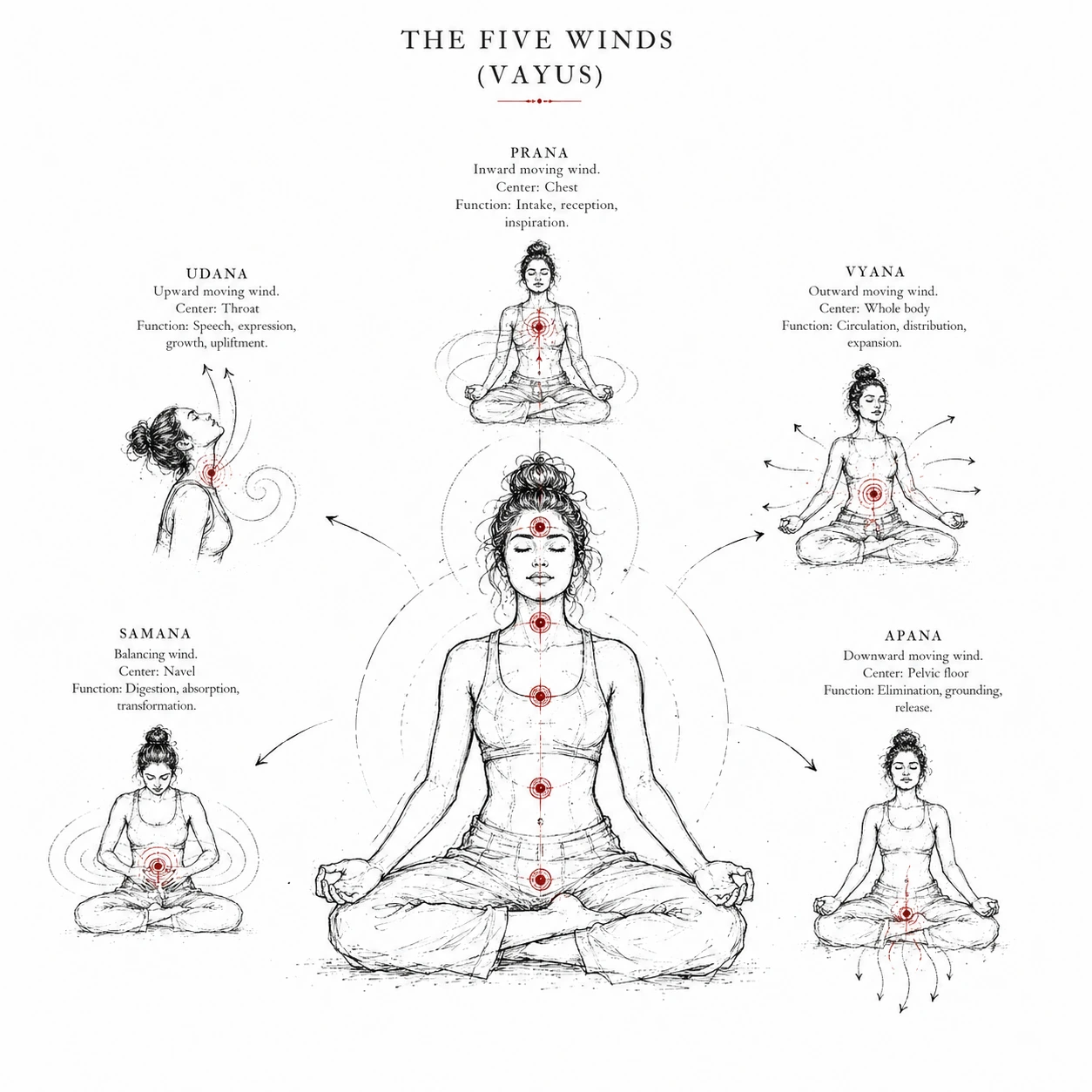
The word vayu translates as “wind” or “movement,” yet these winds are not simply physical breath currents. They describe the directional intelligence through which energy, attention, physiology, and consciousness organize themselves within the organism. In many ways, the Five Vayus represent an ancient energetic map of nervous system function, embodiment, circulation, elimination, communication, and internal regulation.
Rather than existing separately, the vayus constantly interact with one another. When balanced, they create vitality, clarity, grounding, emotional coherence, energetic flow, and psychological stability. When dysregulated, the organism often experiences anxiety, exhaustion, brain fog, emotional instability, tension, digestive dysfunction, shallow breathing, or energetic fragmentation.
| Vayu | Action | Location | Movement | Chakra | Element | Expression |
|---|---|---|---|---|---|---|
| Prana | Crystallization | Heart & chest | All-around | Anahata | Air | Cyclical |
| Apana | Elimination | Pelvis | Downward | Muladhara | Earth | Steadiness |
| Vyana | Circulation | All over the body | Outward | Svadisthana | Water | Alignment |
| Udana | Metabolizing | Throat | Upward | Vishuddha & Ajna | Ether | Verbal |
| Samana | Assimilation | Navel | Inward | Manipura | Fire | Internal |
Prana Vayu: The Force of Intake & Vitalization
Prana Vayu governs inhalation, vitality, sensory perception, emotional openness, and the organism’s capacity to receive life. Centered primarily in the heart and chest region, its movement expands in all directions like breath filling the lungs.
When balanced, Prana Vayu creates clarity, inspiration, enthusiasm, emotional openness, and energetic vitality. Dysregulation often manifests as anxiety, shallow breathing, overstimulation, panic, or emotional contraction.
Modern nervous system science increasingly recognizes how breathing patterns directly influence vagal tone, emotional regulation, cardiovascular rhythms, and stress physiology, mirroring many ancient observations surrounding this vayu.
Apana Vayu: The Force of Grounding & Elimination
Apana Vayu governs elimination, grounding, rooting, stability, sexuality, reproduction, and the downward-moving forces of the organism. Its center lies within the pelvis and lower abdomen.
This vayu controls not only physical elimination, but also the organism’s ability to release emotional accumulation, stress activation, and unresolved energetic holding patterns. In somatic terms, many freeze responses and chronic survival contractions become concentrated in the pelvis, hips, psoas, and lower spine.
When balanced, Apana creates steadiness, embodiment, safety, and grounded presence. When disturbed, individuals may experience dissociation, instability, fear, chronic tension, digestive dysfunction, or nervous system hypervigilance.
Vyana Vayu: The Force of Circulation & Integration
Vyana Vayu governs circulation and distribution throughout the entire organism. It regulates movement between all systems of the body, integrating breath, fascia, nervous system signaling, circulation, coordination, and energetic connectivity.
This vayu radiates outward through the whole body, creating expansion, cohesion, and internal communication. In many ways, Vyana resembles the body’s connective intelligence, linking movement, sensation, posture, and energetic flow into one integrated experience.
Balanced Vyana produces fluid movement, energetic coherence, alignment, adaptability, and coordinated motion. Dysregulation often appears as fragmentation, disconnection from the body, circulation problems, rigidity, or lack of embodiment.
Udana Vayu: The Force of Expression & Ascension
Udana Vayu governs speech, communication, cognition, expression, growth, willpower, and upward energetic movement. Located in the throat and head centers, it is associated with verbal expression, self-articulation, imagination, and consciousness expansion.
This vayu influences not only communication with others, but also the internal voice shaping identity and perception. Disturbances in Udana often appear through difficulty expressing emotions, suppressed truth, chronic throat tension, mental confusion, or lack of direction.
In many contemplative traditions, upward energetic experiences associated with meditation, chanting, ecstatic states, and altered consciousness are closely linked to Udana activation.
Samana Vayu: The Force of Assimilation & Transformation
Samana Vayu resides in the navel center and governs digestion, assimilation, metabolism, integration, and internal processing. Associated with the fire element, it transforms food into energy, experience into understanding, and sensation into internal awareness.
This vayu acts like the organism’s internal alchemist. It balances opposing forces while integrating information from both the outer and inner world.
When balanced, Samana creates centeredness, internal power, emotional digestion, clarity, and resilience. Dysregulation often manifests as poor digestion, chronic fatigue, emotional overwhelm, inflammation, or inability to process life experiences fully.
The Five Vayus & Somatic Shaking™
Within the Somatic Shaking™ Method, the Five Vayus can be understood not merely as symbolic spiritual concepts, but as directly embodied movements of breath, energy, fascia, nervous system regulation, emotional flow, and consciousness.
Therapeutic tremor, pandiculation, dynamic meditation, breath, and somatic movement influence all five vayus simultaneously. Tremor supports Apana by helping discharge accumulated stress downward through the body. Dynamic shaking activates Vyana through circulation and energetic expansion. Conscious breathwork regulates Prana. Vocalization and expression stimulate Udana. Internal awareness and embodiment cultivate Samana.
Rather than separating spirituality from physiology, the organism is approached as one integrated field where breath, movement, nervous system activity, emotion, energy, and awareness continuously shape one another.
Perhaps this is why so many ancient systems described human beings not as static structures, but as living movements of consciousness itself.
Until next time… Shakers, Keep The Vibe Alive!
That Shakin' Guy