Let's Shake Hands: Free Connection Call 

The 5 Koshas
Table of Contents
- A Map of the Nervous System, Consciousness & Human Experience
- The Three Shariras
- 1. Sthula Sharira: The Physical Body
- 2. Sukshma Sharira: The Subtle Body
- 3. Karana Sharira: The Causal Body
- The 5 Koshas (Bodies)
- 1. Annamaya Kosha: The Physical Body
- 2. Pranamaya Kosha: The Energy Body
- 3. Manomaya Kosha: The Mental & Emotional Body
- 4. Vijnanamaya Kosha: The Wisdom Body
- 5. Anandamaya Kosha: The Bliss Body
- The Five Koshas & Somatic Shaking™
A Map of the Nervous System, Consciousness & Human Experience
Modern culture has trained people to experience themselves almost exclusively through the mind. Most individuals identify with thoughts, emotions, productivity, social identity, memory, appearance, and psychological narratives while remaining profoundly disconnected from the deeper layers of their own organism. Ancient yogic philosophy approached the human being very differently. Rather than viewing consciousness as something isolated inside the brain, yogic systems described human existence as a multidimensional experience unfolding simultaneously through body, energy, emotion, perception, awareness, and subtle states of consciousness.
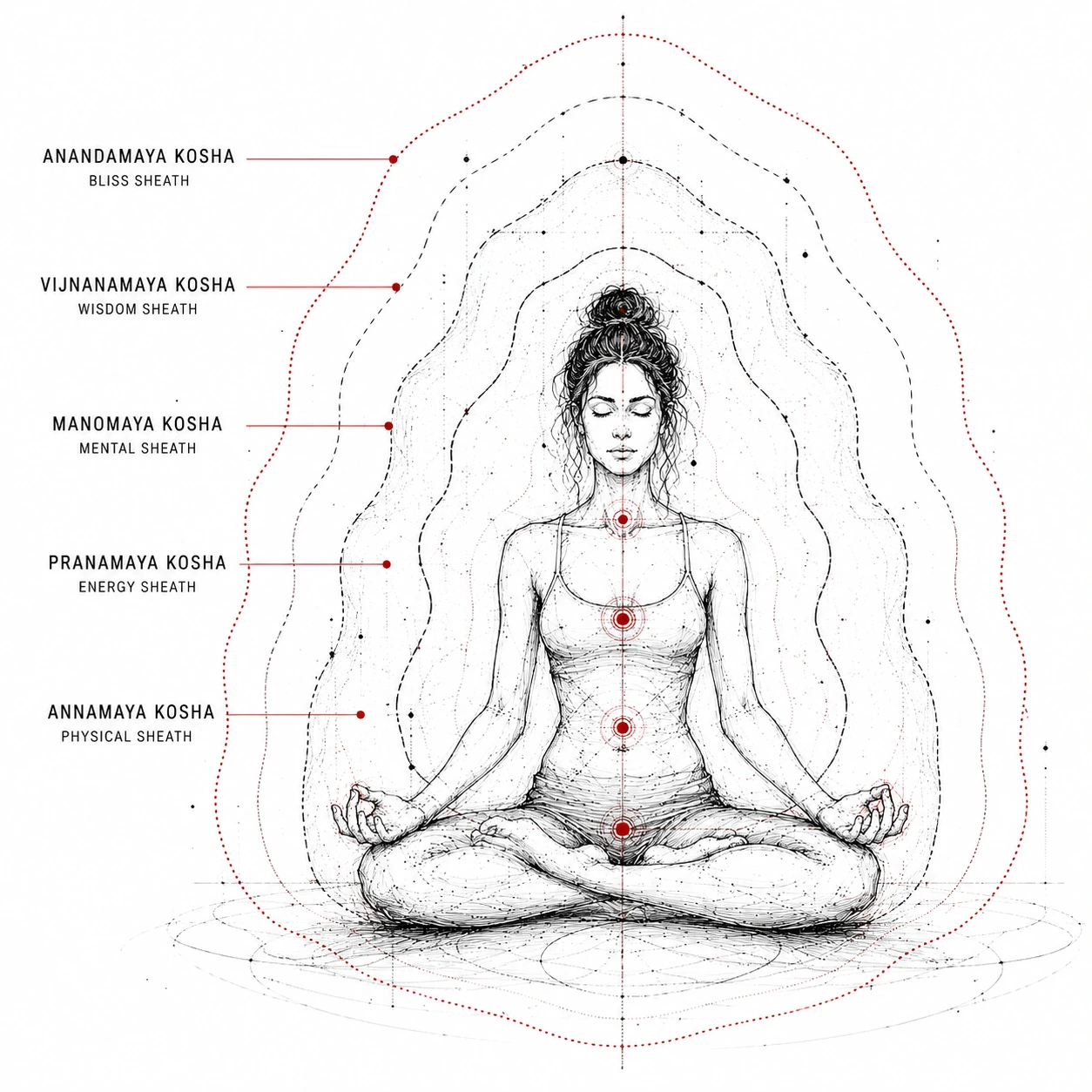
One of the most refined models emerging from the Upanishadic and Vedantic traditions is the concept of the Pancha Koshas, the Five Koshas or “five sheaths” of human existence. These koshas are not separate bodies stacked mechanically on top of one another, but interconnected layers of experience constantly influencing each other through breath, nervous system activity, attention, movement, emotional regulation, energetic flow, and consciousness itself.
Interestingly, many modern discoveries in neuroscience, fascia research, psychophysiology, trauma studies, somatics, and nervous system regulation are beginning to mirror aspects of these ancient observations, although through entirely different language. What yogis described symbolically through prana, koshas, and subtle anatomy increasingly resembles what modern science now understands through autonomic nervous system states, interoception, neuroplasticity, embodied cognition, and the body-brain connection.
The Three Shariras
Alongside the Five Koshas, yogic philosophy also describes human existence through the concept of the Three Shariras, or the three bodies. These represent different dimensions of human experience through which consciousness expresses itself simultaneously.
| BODY | LAYER |
| Sthula | Psysical |
| Sukshma | Subtle |
| Karana | Causal |
1. Sthula Sharira: The Physical Body
The Sthula Sharira is the gross physical body composed of muscles, fascia, organs, bones, fluids, and the nervous system. It is the most tangible aspect of our existence and the layer through which we interact directly with the material world. Modern somatic approaches increasingly recognize that this body stores stress, emotional contraction, posture, trauma responses, and nervous system conditioning physically within the tissues themselves.
2. Sukshma Sharira: The Subtle Body
The Sukshma Sharira includes the energetic, emotional, and mental dimensions of the organism. This subtle body contains prana (life force energy), thoughts, emotions, sensory perception, energetic channels (nadis), and chakras. Breathwork, meditation, tremor, movement, and energetic practices primarily influence this layer, often producing shifts in vitality, emotional regulation, awareness, and internal flow.
3. Karana Sharira: The Causal Body
The Karana Sharira is considered the deepest and most subtle layer, associated with the seed state of consciousness itself. Yogic traditions describe it as the dimension containing karmic impressions, unconscious tendencies, deep memory, and the underlying blueprint from which experience emerges. It is often linked with states of profound stillness, unity, and non-dual awareness beyond ordinary identity and mental activity.
The 5 Koshas (Bodies)
1. Annamaya Kosha: The Physical Body
The first sheath is the Annamaya Kosha, often translated as the “food body.” This is the densest layer of our existence, composed of muscles, fascia, bones, organs, tissues, fluids, posture, movement patterns, and biochemical processes. It is sustained by nutrition, sleep, movement, environment, and respiration.
Most people believe this is all they are. Yet even modern neuroscience confirms that the body is not merely a passive structure directed by the brain. The body itself contains enormous sensory intelligence. Fascia forms a continuous communication network throughout the organism. The vagus nerve links emotional states directly to visceral organs. Muscular tension patterns store stress physiology over time.
This is why chronic anxiety often appears physically through jaw tension, collapsed breathing, digestive dysfunction, tightened hips, forward posture, insomnia, and nervous system hypervigilance. The body becomes biography made visible.
The Annamaya Kosha is not simply anatomy. It is living memory.
2. Pranamaya Kosha: The Energy Body
The second sheath is the Pranamaya Kosha, the energetic body animated by *prana*, the subtle life force described throughout yogic systems. Traditional texts explain that prana flows through nadis, energetic pathways connecting breath, vitality, emotion, movement, and consciousness.
While modern science does not use the same terminology, there are striking parallels between these ancient descriptions and contemporary understandings of autonomic activation, bioelectric signaling, breath regulation, fascial conductivity, and psychophysiological coherence.
Breath dramatically changes emotional state. Posture influences hormonal expression. Tremor alters nervous system discharge. Rhythm reorganizes physiology. Human beings are not simply biochemical organisms, but oscillatory systems continuously exchanging information through electricity, pressure, vibration, sensation, and movement.
This is why practices involving breathwork, shaking, tremor, chanting, meditation, and conscious movement often produce experiences described as energetic awakening. In many cases, the organism is regaining internal fluidity after prolonged contraction and dysregulation.
3. Manomaya Kosha: The Mental & Emotional Body
The Manomaya Kosha represents the psychological and emotional layer of human experience. It includes thought patterns, sensory processing, emotional conditioning, internal narratives, attention, memory, fears, desires, and learned behavioral responses.
Modern humans spend enormous amounts of time trapped within this sheath. Social media, chronic stress, information overload, unresolved trauma, overstimulation, and fragmented attention continuously shape the emotional nervous system.
One of the most important insights emerging from both somatic psychology and contemplative traditions is that the mind does not exist independently from the body. Thoughts influence physiology, but physiology also shapes thought. Chronic sympathetic activation alters emotional perception. Sleep deprivation affects cognition. Breathing patterns influence anxiety levels. Trauma reshapes attentional processing.
The Manomaya Kosha constantly interacts with the nervous system. The body and mind form one continuous loop.
4. Vijnanamaya Kosha: The Wisdom Body
The Vijnanamaya Kosha is associated with discernment, intuition, witnessing awareness, deeper intelligence, and insight beyond reactive thinking. This sheath becomes more accessible when internal noise decreases and nervous system regulation increases.
Many people mistake intuition for mystical fantasy, yet intuition often emerges through subtle interoceptive awareness — the organism’s ability to sense internal signals before they become conscious thoughts. The body frequently perceives reality before the analytical mind fully interprets it.
This sheath represents the transition from compulsive reaction toward conscious observation. Rather than being entirely controlled by emotional conditioning or survival responses, the individual begins developing the capacity to witness experience with greater clarity and presence.
5. Anandamaya Kosha: The Bliss Body
The deepest sheath is the Anandamaya Kosha, commonly translated as the “bliss body.” This layer does not refer to emotional excitement or constant happiness, but to profound internal coherence, stillness, connectedness, and presence.
Many contemplative traditions describe moments where the ordinary fragmentation between body, mind, breath, sensation, and awareness temporarily dissolves. In these states, existence feels unified, spacious, grounded, and deeply alive.
Interestingly, nervous system research increasingly shows that states of safety, regulation, social connection, vagal tone, deep parasympathetic activation, and meditative absorption dramatically alter perception of self and reality. Ancient yogis described these experiences symbolically through koshas long before modern neuroscience existed.
The Five Koshas & Somatic Shaking™
Within the Somatic Shaking™ Method, the koshas are approached not merely as spiritual philosophy, but as directly lived human experiences expressed through the body and nervous system.
Therapeutic tremor, pandiculation, dynamic meditation, breath, and somatic movement influence multiple layers simultaneously. The physical body releases chronic contraction and fascial tension. The energetic body regains vitality and flow. The emotional body begins discharging accumulated stress activation. Attention reorganizes. Awareness deepens. Presence emerges naturally.
Rather than attempting to transcend the body, Somatic Shaking™ works through embodiment itself. The organism is allowed to tremble, breathe, expand, release, reorganize, and reconnect with its own instinctive intelligence.
Perhaps this is what the ancient traditions were ultimately pointing toward from the beginning: not escape from human experience, but full participation within it.
Until next time… Shakers, Keep The Vibe Alive!
That Shakin' Guy