Let's Shake Hands: Free Connection Call 

The 5 Elements
Table of Contents
Understanding the Five Elements of Nature in Yoga, Ayurveda & Consciousness
One of the oldest foundations of yogic philosophy, Ayurveda, Tantra, and many Eastern systems of thought is the concept of the Pancha Bhutas the Five Great Elements of Nature. According to these traditions, all existence emerges from five primordial forces: Earth, Water, Fire, Air, and Ether.
These elements are not viewed merely as physical substances, but as organizing principles governing the structure of matter, the nervous system, consciousness, emotion, movement, physiology, and energetic experience itself. In many ways, the Pancha Bhutas represent an ancient attempt to understand the patterns through which life expresses itself across both the outer world and the inner human experience.
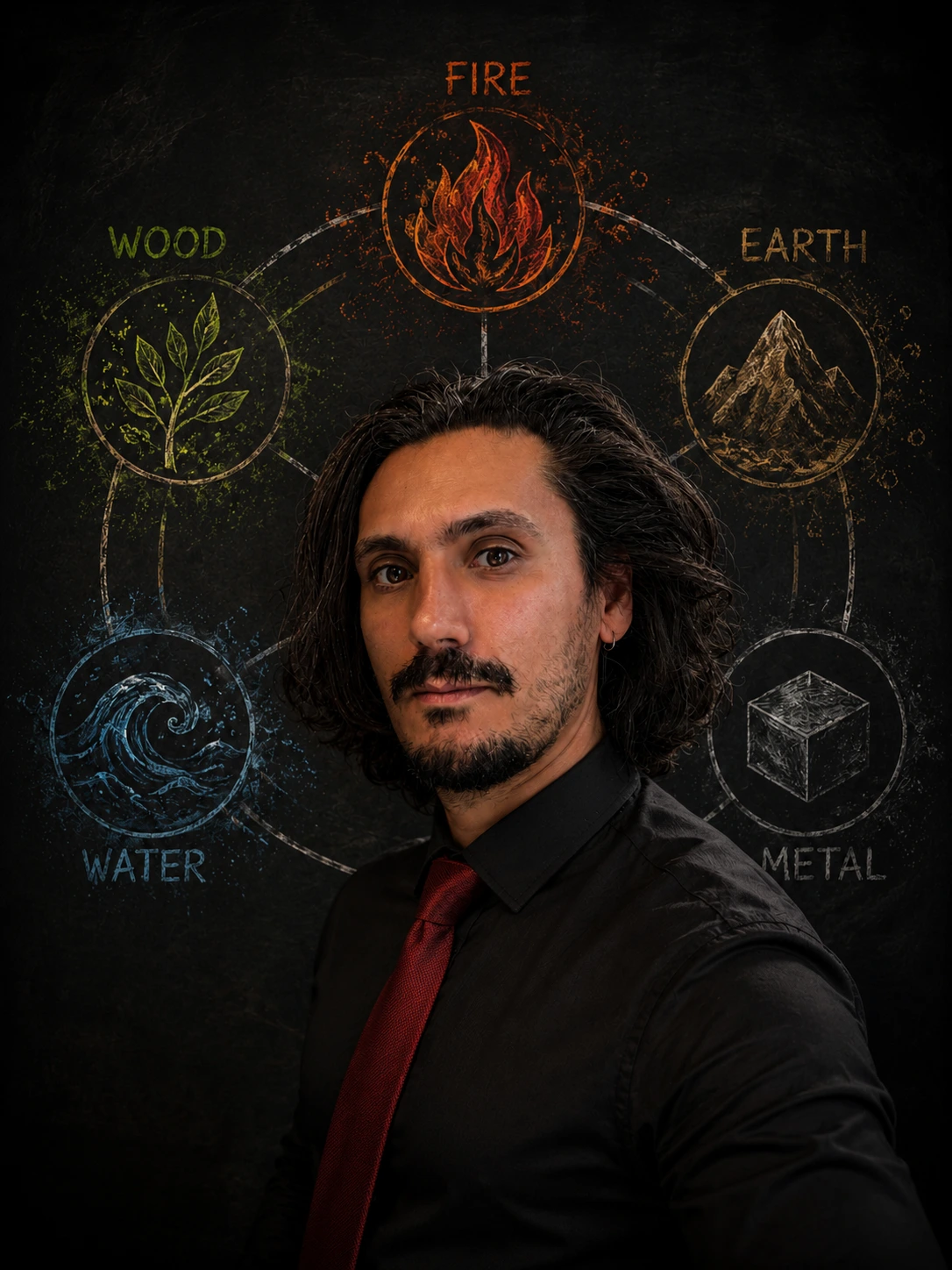
Modern science uses different language, yet there are fascinating parallels. Biology, neuroscience, psychophysiology, and ecology increasingly reveal that the human organism constantly mirrors natural processes: fluid regulation, electrical signaling, thermodynamics, respiration, vibration, rhythm, pressure, and spatial awareness. Ancient yogis observed these same principles symbolically through the language of the elements.
| Element | Sanskrit Name | Core Quality | Nervous System Expression |
|---|---|---|---|
| Earth | Prithvi / Bhumi | Structure, rootedness, resilience | Stability, grounding, embodiment |
| Water | Apas / Jala | Flow, adaptability, emotional fluidity | Connection, softness, regulation |
| Fire | Tejas / Agni | Vitality, transformation, inner power | Motivation, metabolism, intensity |
| Air | Vayu | Movement, expansion, circulation | Creativity, breath, communication |
| Ether | Akasha | Space, awareness, subtle perception | Presence, intuition, consciousness |
1. Earth Element: Prithvi
- Quality: Structure, Stability & Embodiment
The Earth element represents solidity, grounding, structure, density, and stability. Within the body, it corresponds to bones, muscles, connective tissue, fascia, skin, teeth, and the overall physical architecture of the organism. Psychologically, it governs safety, steadiness, resilience, patience, and the capacity to remain present under pressure.
When balanced, the Earth element creates a sense of rootedness, endurance, emotional stability, and embodiment. Dysregulation often manifests as anxiety, dissociation, instability, chronic insecurity, nervous system hypervigilance, or feeling disconnected from the body itself.
Many modern humans suffer from a weakened Earth element because contemporary life continuously pulls attention away from direct embodied experience and into overstimulation, abstraction, and chronic cognitive activity.
2. Water Element: Apas
- Quality: Emotion, Flow & Adaptability
The Water element governs fluidity, emotional movement, adaptability, sensuality, circulation, sexuality, lubrication, and relational connection. Within the body, it corresponds to blood, lymph, interstitial fluids, hormones, and emotional flow.
Water teaches adaptability. A healthy nervous system behaves similarly to water: flexible, responsive, fluid, and capable of shifting states naturally without remaining rigidly trapped in defense patterns.
When the Water element becomes dysregulated, emotional stagnation, suppression, rigidity, numbness, or overwhelming emotional flooding may emerge. Somatically, many individuals carry unresolved emotional tension through restricted breathing, pelvic contraction, fascial tightness, and reduced fluidity throughout the body.
This is one reason practices involving tremor, movement, breath, shaking, and emotional release often feel deeply restorative. The organism regains internal flow.
3. Fire Element: Agni
- Quality: Transformation, Metabolism & Willpower
The Fire element represents transformation, metabolism, digestion, motivation, perception, vitality, intensity, and inner power. Ayurveda associates *Agni* not only with digestion of food, but also with digestion of thoughts, emotions, experiences, and life itself.
Within the body, Fire governs metabolic processes, hormonal activity, temperature regulation, neural activation, focus, ambition, and energetic drive. Psychologically, it influences discipline, clarity, courage, passion, and direction.
Balanced Fire creates vitality, purpose, healthy motivation, and psychological sharpness. Excessive Fire may manifest as aggression, inflammation, burnout, perfectionism, or chronic sympathetic nervous system activation. Deficient Fire often appears as fatigue, low motivation, brain fog, emotional heaviness, or lack of direction.
Modern burnout culture frequently dysregulates the Fire element by maintaining the organism in chronic overactivation without sufficient recovery or discharge.
4. Air Element: Vayu
- Quality: Movement, Breath & Nervous System Activity
The Air element governs movement, respiration, circulation, thought, nerve impulses, sensory activity, and communication throughout the organism. In yogic systems, Air is deeply connected with *prana*, the life force moving through breath and the nervous system.
The mind itself behaves similarly to air: constantly moving, shifting, oscillating, and changing direction. Breath, attention, emotion, and nervous system states are intimately linked through this element.
Balanced Air creates creativity, adaptability, mental clarity, curiosity, and healthy energetic movement. Dysregulated Air often appears as anxiety, overthinking, insomnia, hypervigilance, attentional fragmentation, shallow breathing, and nervous system overstimulation.
This becomes especially relevant in the technological era, where excessive information exposure continuously overstimulates the Air element, fragmenting attention and destabilizing nervous system regulation.
5. Ether Element Akasha
- Quality: Space, Consciousness & Perception
Ether, or Akasha, is the subtlest of the five elements. It represents space, openness, vibration, consciousness, perception, and the field within which all experience occurs.
Without space, no movement, sound, breath, thought, or transformation could exist. Ether governs listening, awareness, intuition, silence, and the subtle dimensions of human perception.
In contemplative traditions, meditation practices often cultivate Ether by reducing internal noise and increasing awareness of spaciousness within both mind and body.
Balanced Ether creates openness, intuition, perspective, creativity, and connection. Dysregulation may appear as dissociation, disconnection from reality, lack of grounding, escapism, or excessive abstraction detached from embodied life.
The Five Elements & Somatic Shaking™
Within the Somatic Shaking™ Method, the Pancha Bhutas can be understood not only symbolically, but through direct embodied experience.
Therapeutic tremor strengthens the Earth element through grounding and nervous system regulation. Pandiculation restores Water through fluid movement and fascial elasticity. Dynamic shaking activates Air through breath, circulation, and energetic motion. Internal heat generated through movement stimulates Fire and metabolic vitality. Deep presence, awareness, and embodiment cultivate Ether.
Rather than separating spirituality from physiology, the body is approached as a living ecosystem where movement, breath, emotion, fascia, nervous system states, energy, and consciousness continuously shape one another.
Perhaps this is why ancient systems consistently returned to nature when attempting to understand the human being: because the body itself is nature expressing consciousness through form.
Until next time… Shakers, Keep The Vibe Alive!
That Shakin' Guy