Let's Shake Hands: Free Connection Call 

The 7 Chakras
Table of Contents
- Understanding the Energetic Centers of the Human Body
- 1. Muladhara Chakra: The Root Center
- 2. Svadhisthana Chakra: The Sacral Center
- 3. Manipura Chakra: The Navel Center
- 4. Anahata Chakra: The Heart Center
- 5. Vishuddha Chakra — The Throat Center
- 6. Ajna Chakra: The Third Eye
- 7. Sahasrara Chakra: The Crown Center
- The Chakras & Somatic Shaking™
- A Note on the Origins of the Chakra System
Understanding the Energetic Centers of the Human Body
Within yogic and tantric philosophy, the chakras are described as psychoenergetic centers through which consciousness, emotion, instinct, perception, and life force energy organize themselves within the human organism. The word chakra translates as “wheel,” symbolizing dynamic centers of movement, transformation, and energetic exchange.
Although often interpreted purely symbolically or spiritually, chakras can also be understood through the lens of the nervous system, endocrine glands, emotional regulation, embodied psychology, fascia, instinctive behavior, and human development. Each chakra represents a different dimension of survival, identity, expression, connection, perception, and awareness.
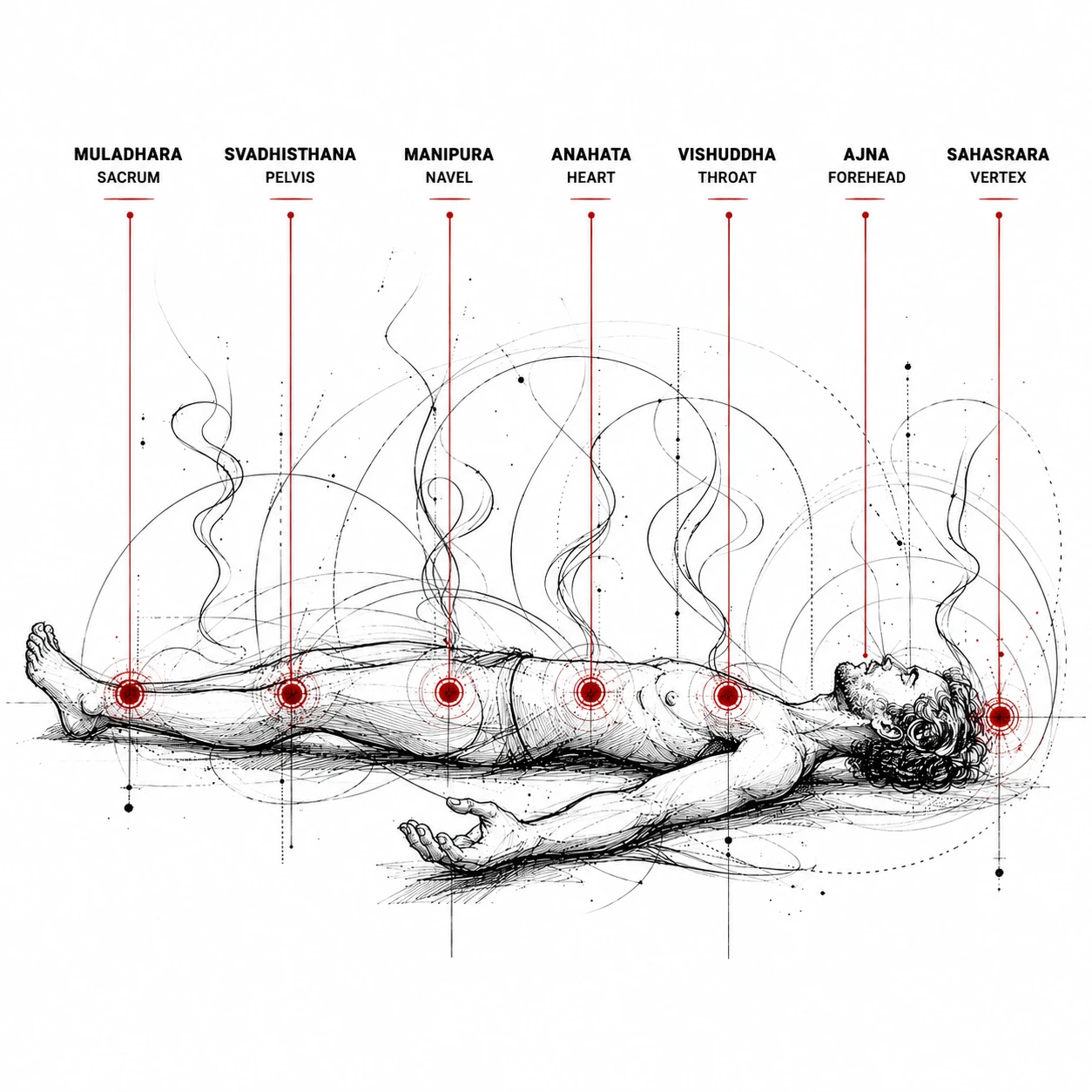
Rather than existing separately, the chakras continuously influence one another, much like interconnected layers of physiology and consciousness.
| Chakra | Location | Element | Core Theme | Nervous System Expression |
|---|---|---|---|---|
| Muladhara | Sacrum | Earth | Survival, grounding, safety | Stability, embodiment, regulation |
| Svadhisthana | Pelvis | Water | Emotion, sexuality, flow | Adaptability, emotional movement |
| Manipura | Navel | Fire | Power, will, transformation | Motivation, metabolism, confidence |
| Anahata | Heart | Air | Love, connection, compassion | Openness, empathy, emotional balance |
| Vishuddha | Throat | Ether | Expression, truth, communication | Voice, authenticity, articulation |
| Ajna | Forehead | Light / Mind | Intuition, perception, awareness | Insight, cognition, inner vision |
| Sahasrara | Vertex | Pure consciousness | Unity, transcendence, presence | Stillness, spiritual integration |
1. Muladhara Chakra: The Root Center
The Muladhara chakra governs survival, grounding, physical identity, safety, and the organism’s relationship with stability. Located at the base of the spine and associated with the Earth element, this center relates deeply to the nervous system’s perception of safety and embodiment.
When balanced, Muladhara creates groundedness, resilience, trust in life, and physical presence. Dysregulation often manifests as chronic anxiety, hypervigilance, dissociation, instability, financial fear, or difficulty feeling “at home” within the body.
2. Svadhisthana Chakra: The Sacral Center
Located within the pelvis and lower abdomen, Svadhisthana governs emotion, sensuality, sexuality, creativity, pleasure, adaptability, and relational flow. Associated with the Water element, this chakra reflects the organism’s ability to feel, connect, and move emotionally without rigidity.
Imbalances may appear as emotional suppression, shame, numbness, addictive behaviors, or instability in relationships and emotional regulation.
3. Manipura Chakra: The Navel Center
The Manipura chakra resides around the navel region and corresponds to the Fire element. It governs willpower, digestion, transformation, confidence, personal power, metabolism, and energetic vitality. It’s also known as the ‘nabhi chakra’, meaning ‘the navel chakra’.
A balanced Manipura supports healthy boundaries, motivation, courage, and internal strength. Dysregulation may manifest as burnout, low self-worth, chronic fatigue, digestive dysfunction, aggression, perfectionism, or excessive control.
4. Anahata Chakra: The Heart Center
The Anahata chakra, located in the heart and chest region, is associated with the Air element and governs compassion, love, grief, empathy, connection, forgiveness, and emotional openness.
Modern nervous system research increasingly highlights how emotional regulation, vagal tone, breath, and social connection directly influence cardiovascular rhythms and psychological wellbeing, echoing many ancient insights surrounding the heart center.
Balanced Anahata creates emotional coherence, warmth, openness, and relational harmony. Dysregulation may appear as emotional isolation, grief retention, guardedness, or difficulty receiving love and support.
5. Vishuddha Chakra — The Throat Center
The Vishuddha chakra governs expression, communication, truth, authenticity, sound, and self-articulation. Located in the throat and linked with the Ether element, this center influences both verbal expression and the ability to communicate emotional reality honestly.
Suppressed emotions, chronic self-censorship, fear of visibility, and unspoken tension often accumulate physically through the throat, jaw, neck, and breath.
Balanced Vishuddha supports clear communication, authenticity, creativity, and aligned self-expression.
6. Ajna Chakra: The Third Eye
The Ajna chakra, commonly known as the third eye, governs intuition, perception, imagination, awareness, symbolic thinking, and inner vision. Located between the eyebrows, it is associated with higher cognition and subtle perception.
Ajna relates not only to mystical insight, but also to pattern recognition, self-awareness, introspection, and the ability to perceive reality beyond immediate emotional reactivity.
Balanced Ajna creates clarity, discernment, intuition, and deeper perception. Dysregulation may manifest as confusion, over-intellectualization, obsessive thinking, fantasy escapism, or disconnection from reality.
7. Sahasrara Chakra: The Crown Center
The Sahasrara chakra represents unity, transcendence, spiritual integration, and expanded consciousness. Positioned at the crown of the head, it is often associated with silence, stillness, awareness, and the dissolution of separation between self and existence.
In many contemplative traditions, this chakra symbolizes the realization that consciousness extends beyond identity, thought, and egoic conditioning. Balanced Sahasrara creates profound presence, spaciousness, connection, and inner peace. Dysregulation may appear as spiritual dissociation, escapism, confusion, or disconnection from embodied reality.
The Chakras & Somatic Shaking™
Within the Somatic Shaking™ Method, the chakra system is approached through direct embodied experience rather than abstract spirituality alone.
Therapeutic tremor, pandiculation, dynamic meditation, breath, fascia release, movement, and nervous system regulation influence multiple energetic centers simultaneously. Tremor helps restore grounding through Muladhara. Pelvic movement activates Svadhisthana. Breath and vitality stimulate Manipura and Anahata. Vocal expression influences Vishuddha. Deep presence and awareness naturally affect Ajna and Sahasrara.
Rather than forcing energetic awakening, the body is allowed to reorganize itself organically through movement, regulation, breath, sensation, and embodiment.
A Note on the Origins of the Chakra System
Although the seven chakra model has become the most widely recognized version in modern spirituality and yoga culture, historically the chakra system was never entirely fixed or universal. The popular seven chakra framework is largely associated with the Shat Chakra Nirupana, a 16th-century tantric text describing six primary chakras along the central channel, often later expanded conceptually into seven through the inclusion of Sahasrara, the crown center.
Across different yogic, tantric, Buddhist, Taoist, and esoteric traditions, there have been many energetic maps containing fewer, additional, or entirely different chakra systems depending on the lineage and purpose of the practice. Some traditions focus on three major centers, others on five, six, seven, nine, twelve, or even far more subtle energetic points throughout the body.
This is important to understand because chakras were never originally intended as rigid anatomical structures or universally identical “energy disks,” but rather as symbolic, experiential, and psychoenergetic models used to describe different dimensions of consciousness, embodiment, transformation, and spiritual development.
In many ways, the map evolved according to the needs, observations, and inner experiences of each tradition.
Until next time… Shakers, Keep The Vibe Alive!
That Shakin' Guy