Let's Shake Hands: Free Connection Call 

Neuroendocrine Theory of Aging and Kundalini Activation
The Neuroendocrine Theory of Aging, developed by Vladimir Dilman and expanded by Ward Dean, proposes that aging is primarily driven by a progressive loss of receptor sensitivity at both central (hypothalamic) and peripheral levels.
Receptors are the interface through which hormones and neurotransmitters exert their effects. When their sensitivity declines, the body no longer responds efficiently to its own signaling systems. The result is a gradual shift in homeostasis, affecting metabolism, hormonal balance, neural signaling, and ultimately the integrity of the organism.
This model becomes particularly relevant in the context of Kundalini activation, which can be understood biologically as a state of heightened metabolic rate and intensified nerve transmission. During such states, the system is not only activated—it is pushed toward its limits of regulation.
Sustained activation places significant pressure on receptor systems, especially those linked to catecholamines (dopamine, norepinephrine, epinephrine) and glutamate-mediated excitation. Over time, this can reduce receptor responsiveness, alter neurotransmitter balance, and destabilize the four core regulatory systems: energy metabolism, stress adaptation (HPA axis), reproduction, and immune function.
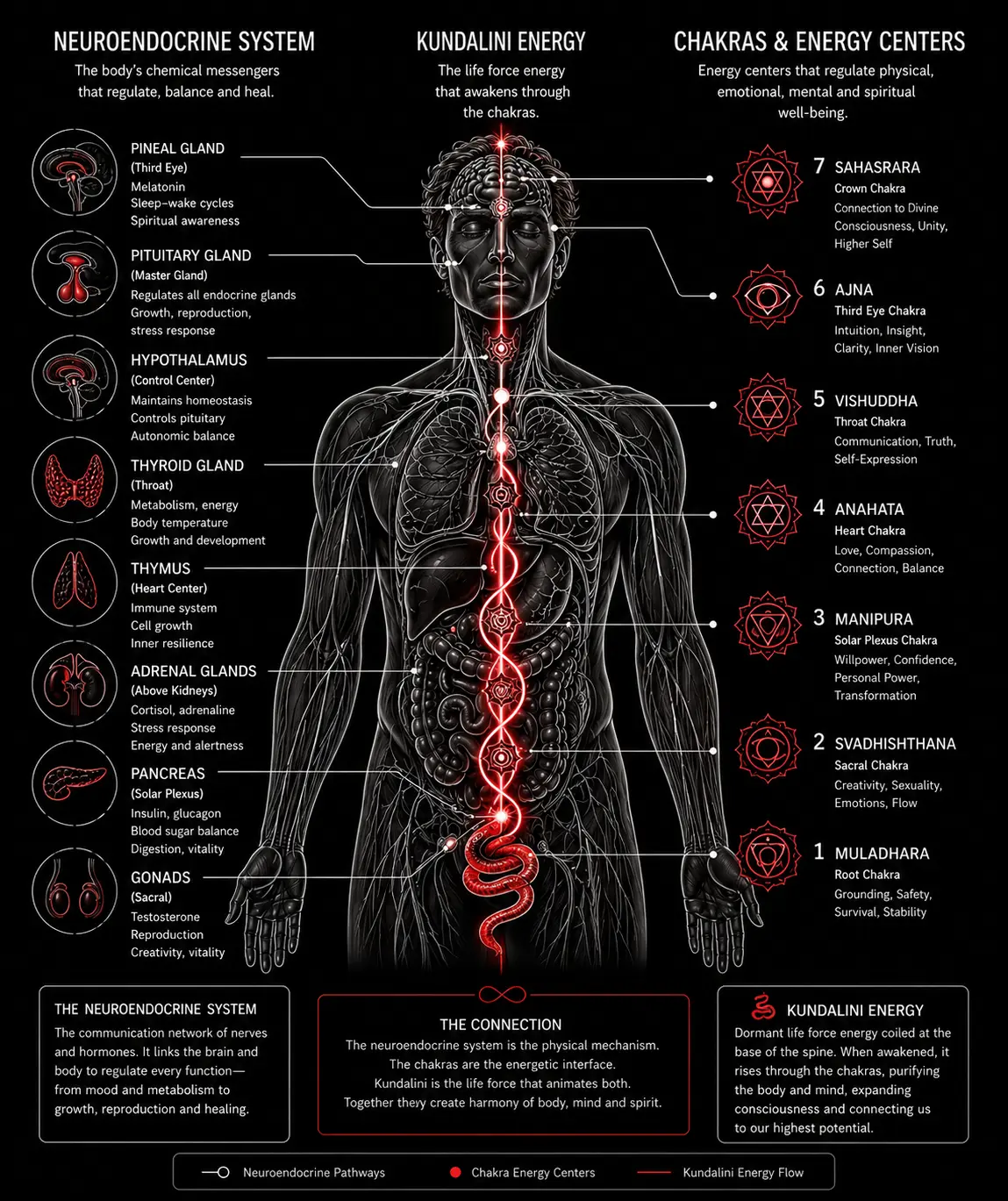
From this perspective, the challenge is not the activation itself, but the system’s capacity to recover receptor sensitivity and restore functional balance after peak states.
The process can be approached through three primary mechanisms:
- Receptor Repair: Oxidative stress and glycation (AGE formation) damage cell membranes, reduce fluidity, and impair receptor number and responsiveness. In high-activation states, excitatory systems such as glutamate and catecholamines are particularly vulnerable, which secondarily affects inhibitory systems like GABA, serotonin, and acetylcholine. Restoring membrane integrity is essential for maintaining signaling precision.
- Use of Precursors: Neurotransmitter synthesis can be supported through amino acid precursors such as tyrosine and phenylalanine (for catecholamines), and tryptophan or 5-HTP (for serotonin). This supports rebalancing of depleted systems and contributes to restoring hypothalamic sensitivity and overall regulatory coherence.
- Inhibition of Neurotransmitter Breakdown: Enzymes such as monoamine oxidase (MAO) degrade catecholamines. With age and chronic stress, MAO activity increases, accelerating the loss of activating neurotransmitters. Modulating this process helps preserve functional levels and maintain a more stable balance between excitatory and inhibitory systems.
In practical terms, recovery from intense activation states also involves reducing free radical damage, stabilizing glucose metabolism, and rebuilding both neurotransmitter levels and receptor sensitivity. This supports the restoration of the body’s four primary homeostatic systems and allows integration at a higher functional level.
Kundalini does not simply “add energy” to the system—it tests the system’s capacity to regulate, adapt, and recover.
When receptor sensitivity is preserved and restored, activation leads to **reorganization and growth**.
When it is not, the same activation leads to imbalance, depletion, and prolonged recovery.
Until next time… Shakers, Keep The Vibe Alive!
That Shakin' Guy