

OM: The Sound That Brings You Back Home
OM, also called Pranava Mantra, is considered one of the most sacred sounds in Hinduism and is integrated into forms of worship, prayer, meditation, and the recitation of sacred texts. Most yoga classes begin and end with the mantra OM or AUM, which means almost everyone has heard of this representative mantra. It is the most widely known mantra in the world and the beginning of many longer mantras.
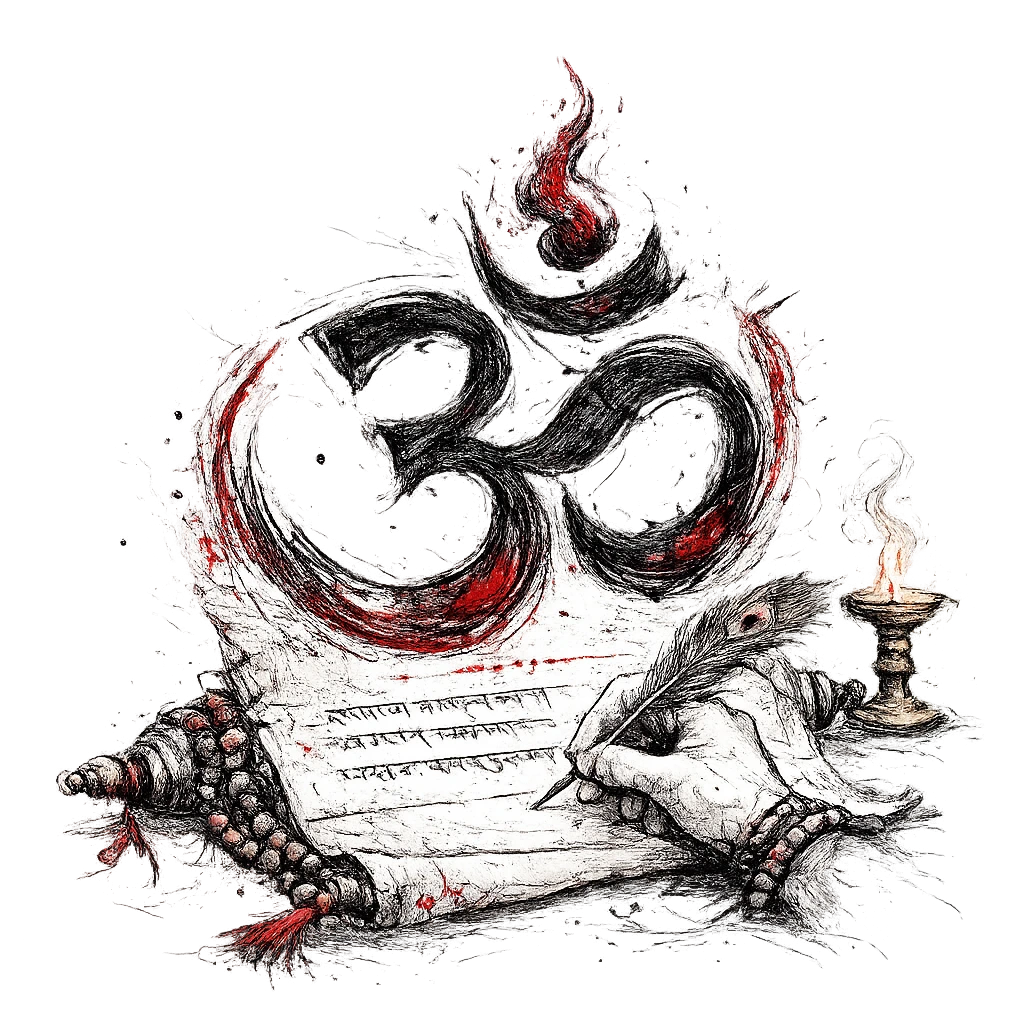
In the yogic tradition, it is considered the primordial vibration that existed before the appearance of the Universe and remains beyond its dissolution. Beyond being connected to one specific deity, OM is the sound-form of Supreme Consciousness, a direct path through which a person can bring the mind, breath, and heart into a deeper state of stillness, into a vibration that moves in unison with the Source of all that exists.
- A The principle of Tamas, inertia
- U The principle of Rajas, passion
- M The principle of Sattva, truth
In Patanjali’s Yoga Sutra, it is said: “tasya vācakaḥ praṇavaḥ” – the sound of Ishvara is Pranava, meaning OM or AUM. Regarding the practice, the recommendation is “its repetition and contemplation of its meaning.” In other words, OM is not chanted mechanically. It is felt, listened to, and lived. It is allowed to descend into the body until the mind no longer runs in every direction.
The Bhagavad Gita calls it “akshara,” the imperishable syllable. Krishna mentions that the one who remembers the Divine and chants OM enters a higher state of consciousness. In another place, He says: “I am Pranava.” And in the formula “OM Tat Sat,” OM first describes the nature of the unmanifest and absolute reality.
The Upanishads go even deeper. Mandukya Upanishad states that AUM contains everything: the past, the present, the future, and that which is beyond time. The sound A-U-M is connected to the waking state, the dream state, deep sleep, and the silence after the sound, that silence in which the human being no longer searches, but recognizes.
Although OM is heard as one single echo, in certain yogic traditions its structure is understood through three and, respectively, five subtle elements:
- Akara (A) represents the waking state, Jagrat, the conscious mind, and the physical body.
- Ukara (U) represents the dream state, Svapna, the subconscious mind, and the subtle body.
- Makara (M) represents deep dreamless sleep, Sushupti, the unconscious mind, and the causal body.
- Bindu, the point, represents the transition into stillness, focus, and concentration.
- Natham, the subtle echo, represents Pure Consciousness, Turiya, the superconscious mind, and transcendence.
This is where the deep beauty of the mantra lives: you begin from the gross nature of the body, move through the subtle layers of the mind, descend into the depths of the unconscious, and then focus into a single point that becomes the portal toward the transcendent space.
Tradition says that the deeper meaning of Pranava Mantra was explained by Skanda to Shiva and later transmitted as hidden knowledge to the sage Vamadeva because of his spiritual dedication. AUM does not have a purely intellectual definition, because it reveals itself to the one who practices.
As for the practice itself, vibrate one of the syllabic forms, AUM or OM. Practice Somatic Shaking and recite the mantra slowly on the exhale. Let the sounds vibrate through the body without forcing the sound out in any way. At the same time, prolong the consonant M until it is absorbed into total silence.
To begin, recite it 3 or 9 times. If you want a steadier practice, use 27 repetitions. For a complete traditional practice, recite it 108 times, a number considered sacred in many yogic traditions. You can chant AUM out loud, in a whisper, or mentally. What matters is that you remain present, with your attention on the vibration, the breath, and the silence that remains after the sound fades. For deeper sadhana, some esoteric traditions speak of 12,500 repetitions a day or 125,000 in one single session, but this level must be approached with maturity, preparation, and reverence, because it awakens the psychic forces known as siddhis.
The OM mantra corresponds to the 432Hz frequency, which is known for its properties:
used in meditation and contemplative practice sassociated with harmony and natural ordersupports ritual and the induction of a contemplative state through association and repetition exploration of nondual states of consciousness energetic balancing
For my vibrant community of Shakers, the mantra represents both an energetic portal toward the ineffable state of identity dissolution and a simple way to calm the nervous system and activate the vagus nerve.
Much Love
Until next time… Shakers, Keep The Vibe Alive!
That Shakin' Guy