Let's Shake Hands: Free Connection Call 

What Is
Shaking Qigong?
Shaking Qigong is a natural method of relaxation and bioenergetic movement meditation. More than just a technique, it is an intuitive and deeply organic practice based on the rhythmic shaking of the body.
Through this process, the organism enters a therapeutic tremor response that helps discharge accumulated tension, stagnant energy, and chronic stress patterns stored within the nervous system and connective tissue.
Rooted in Traditional Chinese Medicine (TCM), this form of vibration therapy has traditionally been used to release physical and emotional tension while restoring the circulation of Qi — the vital life force energy flowing through the body.
By consciously activating shaking and spontaneous movement, the practice stimulates circulation, increases body awareness, enhances energetic flow, and supports greater vitality, emotional balance, and embodied presence.
In many ways, Shaking Qigong is exactly where my own practice began. The human body releases stress much like any other mammal: through trembling, shaking, and spontaneous discharge. At the time, I never expected this to become the foundation of my work. I was still searching for hidden techniques, esoteric transmissions, and mystical initiations somewhere deep in the jungles of Uruvela or among Jaqri shamans in Nepal.
My introduction to Shaking Qigong came through Andrew Fretwell , and I almost always practiced it before internal alchemy (Neidan) formulas.
Over time, especially after settling in Bali, I began to realize that Indonesia holds an extremely advanced tradition of shaking practices. I witnessed rituals performed by various Indonesian medicine men who used shaking either as a spontaneous post-invocation effect or as a direct method for energetic purification and opening the channels through which kundalini energy evolves.
In Somatic Shaking Qigong, we draw from traditional Chinese concepts while expanding our perception toward newer horizons of understanding within the energetic arts.
How Can Shaking Qigong
Help You?
The benefits of Shaking Qigong range from relaxing the physical body and reducing discomfort to emotional release, nervous system regulation, and the transformation of old behavioral patterns.
- Improved circulation by stimulating blood flow and lymphatic movement.
- Greater mobility and agility by relaxing the muscles, joints, and connective tissue.
- Mind-body connection by awakening vital energy while increasing presence and body awareness.
- Stress reduction by releasing emotional tension, physical blocks, and accumulated survival activation.
Shaking Qigong & Waidangong
Shaking Qigong is part of a 2,000-year-old tradition known as Waidangong. In Chinese tradition, this form of Qigong uses voluntary flexion of the fingers and toes to trigger an autogenic shaking response.This response appears to tap into an autonomic nervous system reflex closely connected to the release of sympathetic fight-or-flight activation. A similar principle appears in Seiki Jutsu, sometimes described as shaking medicine. What makes the practice unique is that it is not only somatic; it is also energetic, directly activating and moving vital life force energy.Out of the 12 core movements, ten focus on shaking the body in different positions. These exercises were traditionally kept secret and passed down within families for generations. In 1976, Master Chih-Tung Chang in Taiwan made them available to the general public.The method spread rapidly across Japan and Southeast Asia, supported by countless healing testimonials from practitioners, eventually reaching more than 3 million followers.Within the discipline of Waidangong, there is a strong emphasis on 100 days of uninterrupted daily practice as the threshold for the first transformation. The first signs of progress are described as two stages: the healing of physical ailments and the reversal of the aging process.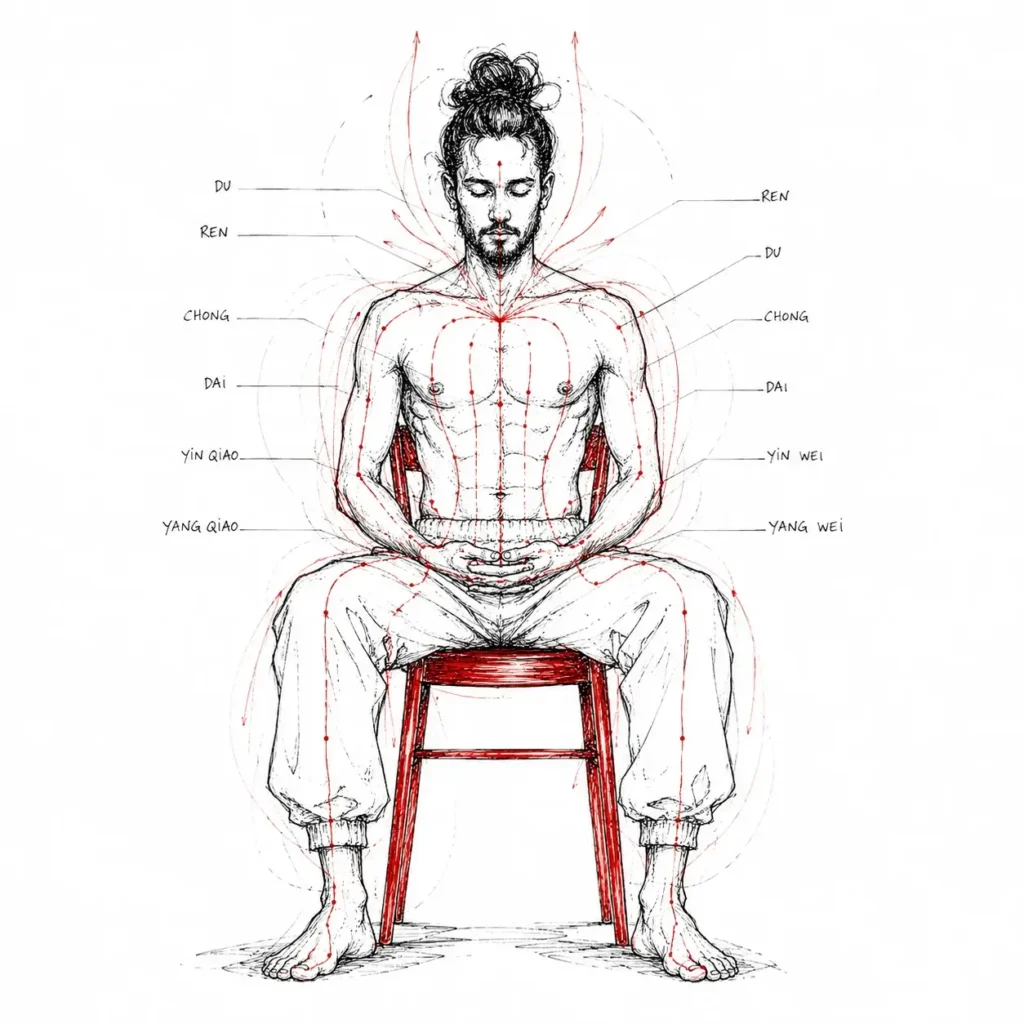
Activation
Methods
To initiate the energetic unblocking process, you can use one of the following activation methods. Each approach stimulates the body differently, allowing the shaking response to emerge naturally and spontaneously.
1. Primary Method
- Starting Position Stand with your feet shoulder-width apart and soften your gaze. Let the arms hang naturally while keeping the knees slightly bent and relaxed.
- Activation Point your index fingers upward and remain receptive. Allow the body to gradually enter the shaking response on its own.
- Triggering the Movement If the shaking does not begin immediately, gently bounce the arms from the shoulders for a few moments. The vibration typically becomes spontaneous shortly afterward.
2. Limb Flexion Method
- Sole Activation While sitting, standing, or lying down, flex the ankle upward and downward 9 times, then relax completely and observe the body. Practice one leg at a time. This method strongly stimulates the Kidney meridian, which begins in the sole of the foot.
- Palm Activation You may also activate the process by flexing the fingers 9 times and then allowing the vibration to spread naturally through the hands and arms.
Duration & Evolution
- Practice Duration Begin with 5-minute sessions and progressively extend the practice up to approximately 30 minutes.
- Movement Expression Every body expresses shaking differently. Some people experience strong releases, while others notice subtle waves, pulsations, or micro-vibrations.
Emotional Release
The shaking process may bring previously suppressed emotions to the surface. If the emotional intensity becomes overwhelming, you can stop the practice at any moment. As the body gradually releases accumulated tension and energetic blockages, many practitioners report entering states of deep relaxation, emotional lightness, and spontaneous joy.
Qigong Shaking
& Whole Body Vibration
A fascinating question often explored by practitioners is whether Qigong Shaking — self-generated somatic shaking — can create effects comparable to Whole Body Vibration (WBV) therapies.
WBV platforms use mechanical oscillations between approximately 15–70 Hz to stimulate reflexive muscle contractions, balance, circulation, bone density, and neuromuscular activation. By contrast, conscious self-generated shaking typically operates at much lower frequencies, around 4–5 Hz, depending on mobility, relaxation, and movement amplitude.
What Research Suggests
- Self-Generated vs Mechanical Vibration Research published on ScienceDirect suggests that WBV devices provide therapeutic consistency through controlled vibration dosage. However, similar physiological effects may also emerge through intentional self-generated movement when practiced with sufficient intensity, duration, and regularity.
- Nervous System Regulation Shaking is not merely muscular movement. It is deeply connected to autonomic regulation and stress discharge. Similar mechanisms are explored in approaches such as TRE® developed by Dr. David Berceli, where spontaneous tremors are viewed as biological responses that help release accumulated tension.
- Therapeutic & Psychological Effects Findings documented in PubMed Central indicate that shaking, vibration, and rhythmic somatic movement may support psychological well-being, body awareness, circulation, and fluid movement throughout the organism.
A Practical Perspective
From a direct sensory perspective, an intense and conscious 10-minute session of Qigong Shaking can create a feeling of activation, circulation, warmth, and physiological invigoration comparable to spending 10 minutes on a trampoline.
While vibration technology offers mechanical precision, Qigong Shaking introduces something fundamentally different: a deep mind-body connection and the organism’s innate capacity to self-regulate tension, movement, and energetic flow from within.
Waidangong
Practice Structure
Waidangong consists of 12 movements, along with one preliminary activation movement and one Qi-releasing movement. The practice is divided into three progressive sections.
- Section 1 The preliminary movement followed by the first four movements.
- Section 2 The middle four movements deepen circulation, coordination, and energetic flow.
- Section 3 The final four movements followed by the essential Qi-releasing movement.
The Golden Rule of Sequence
Always follow the correct order: preliminary movement → main movements → Qi release. Skipping the final Qi-releasing movement may create energetic imbalance or unwanted side effects. If time is limited, perform the preliminary movement plus 1–2 movements, but always finish with Qi release.
Practice Guidelines
- Medical Consultation Consult your physician before beginning. If these exercises are not recommended for your condition, avoid practicing.
- Food & Digestion Do not practice immediately after eating. Practice before meals or at least two hours after eating.
- Beverages Avoid ice water or cold drinks immediately after practice. Warm beverages are recommended. Cold drinks should wait at least 30 minutes.
- Bathing Avoid showers or baths immediately after practice. Wait at least 30 minutes to prevent energetic depletion and fatigue.
- Rest & Sleep Do not go directly to sleep after practice. Allow the body at least 30 minutes to stabilize.
- Women’s Guidelines Waidangong should not be practiced during menstruation or pregnancy.
Somatic Shaking Qigong
From Freeze
To Flow
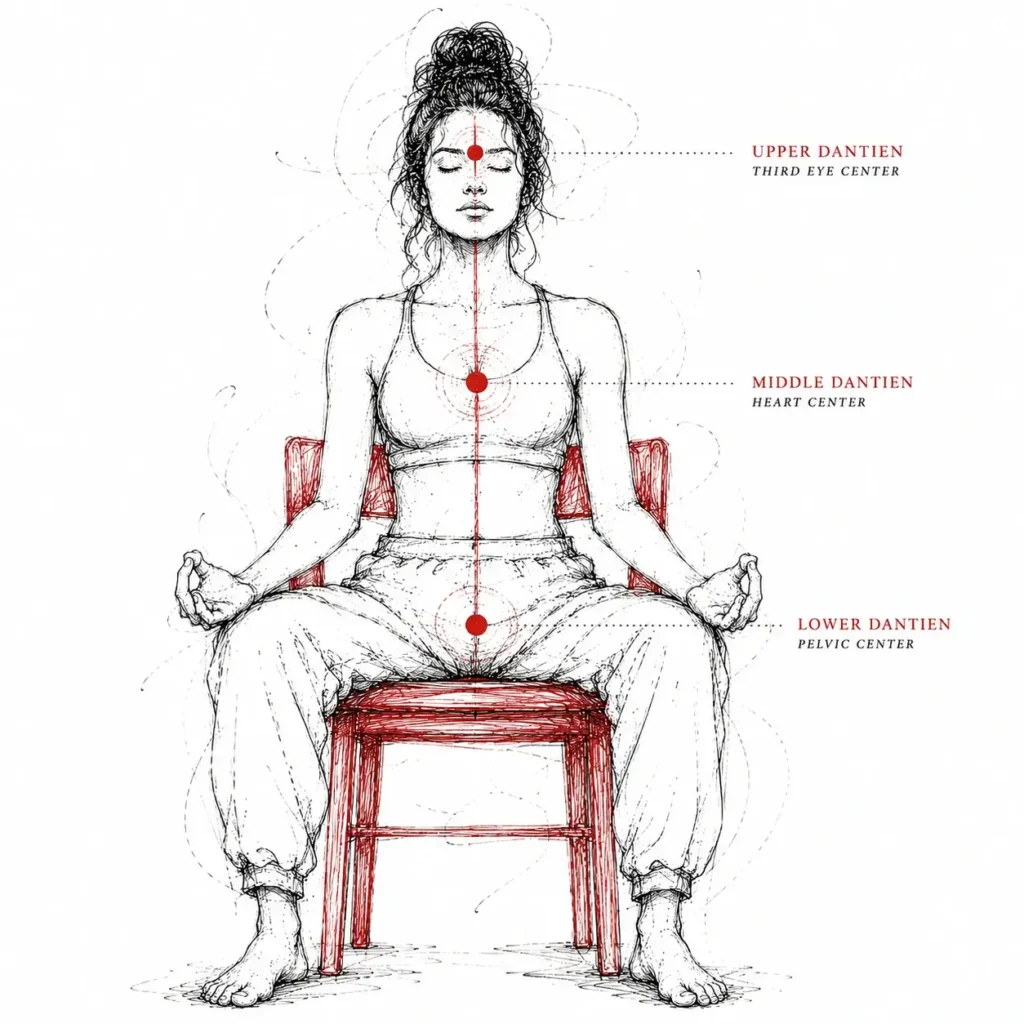
In Somatic Shaking Qigong, we work with the body’s natural intelligence to restore movement, energy, and inner regulation. The practice focuses on releasing stagnation through the meridian system while bridging nervous system science with the deeper energetic wisdom of Qigong.
Unlike classical Somatic Shaking, where we may use titration, pendulation, voluntary pandiculation, or Kundalini-based energetic work, this practice focuses on one essential transition: moving from Freeze into Wu Wei — effortless flow, spontaneous alignment, and regulated action.
- ✓Freeze / Stagnation A state of contraction, shutdown, dissociation, and deep internal resistance. Energy becomes locked and unavailable.
- ✓Fight or Flight / Overactivation A state of excessive fire. Energy rises chaotically toward the head, creating tension, pressure, anxiety, or exhaustion.
- ✓Fawn / Divided Energy The outside appears agreeable and active while the core of the body feels empty, frozen, or disconnected from authentic boundaries.
- ✓Wu Wei / Flow A regulated state where the body becomes fluid, grounded, adaptive, and naturally aligned with life instead of resisting it.
Wu Wei is often misunderstood as passivity. In its deeper meaning, it refers to effortless action — a state where breath, movement, nervous system, and energy begin to work together naturally.