Let's Shake Hands: Free Connection Call 

Nadis: Meaning & Definition
Table of Contents
- What Are Nadis?
- The three main Nadis
- Ida Nadi: The Lunar Channel
- Pingala Nadi: The Solar Channel
- The Sushumna Nadi: The Central Axis of Balance
- Kanda and Yukta Triveni
- 14 major nadis
- The three knots
- Brahma Granthi: The Knot of Survival
- Vishnu Granthi: The Knot of Emotion
- Rudra Granthi: The Knot of Perception
- Traditional Yoga: The Disciplined Path
- Somatic Shaking: The Biological “Reset”
Yogic traditions have long viewed the human body as something far deeper than just a collection of flesh and bone. Ancient practitioners mapped out an energetic anatomy made of subtle channels called nadis, which act as pathways for prana, or life force, to flow through the entire system. Interwoven with our physical form, these invisible streams were understood to shape everything from our daily vitality and emotions to our deeper perception and spiritual growth.
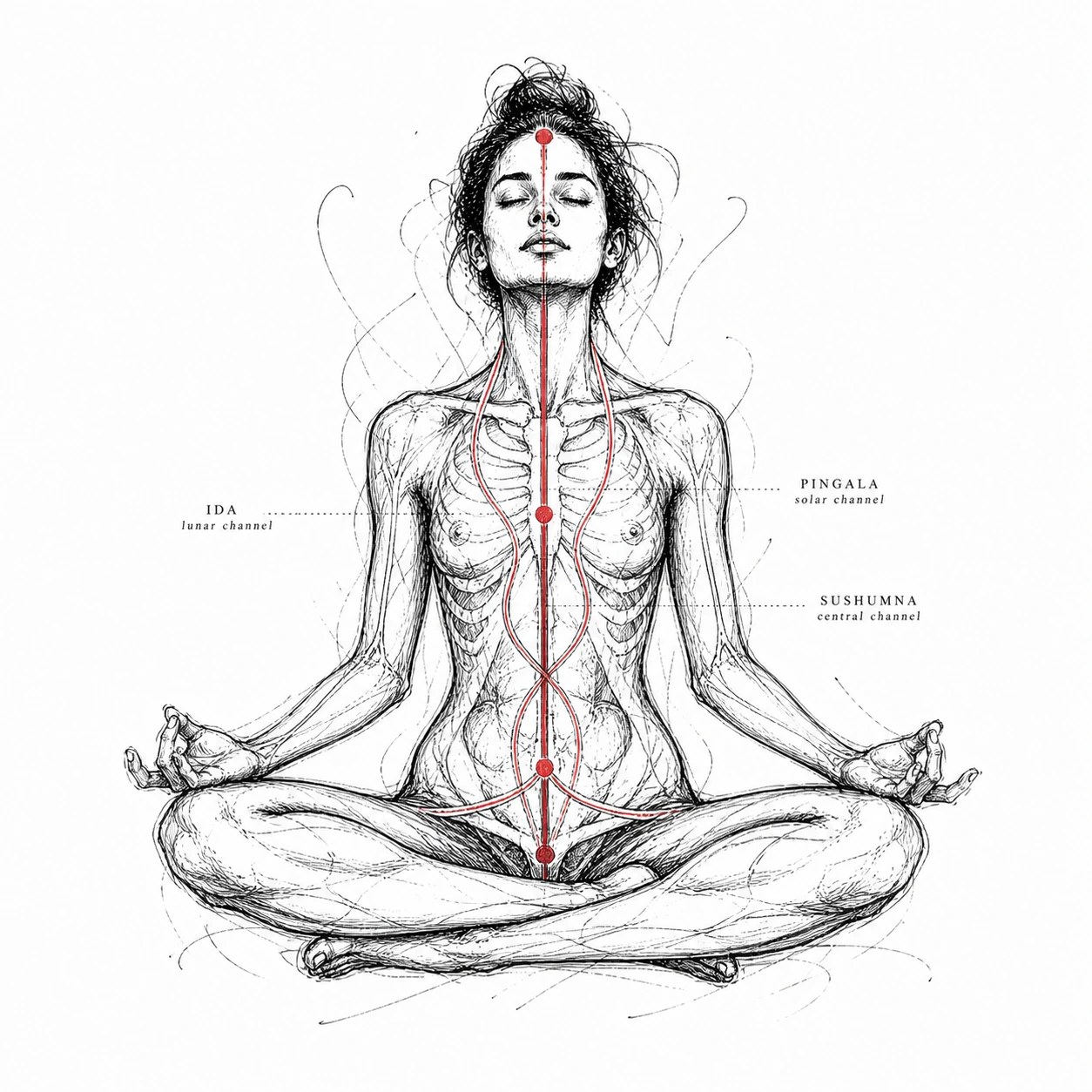
Modern science doesn’t categorize nadis as physical structures like veins or nerves. Yet, the way ancient yogic traditions describe them creates a clear bridge to what we now understand about the nervous system, autonomic regulation, and the mechanics of breath. These traditional maps reflect the same psychophysiological shifts we see during meditation, altered states of consciousness, and intense somatic experiences.
| Nadi | Associated Energy | Pathway & Function |
|---|---|---|
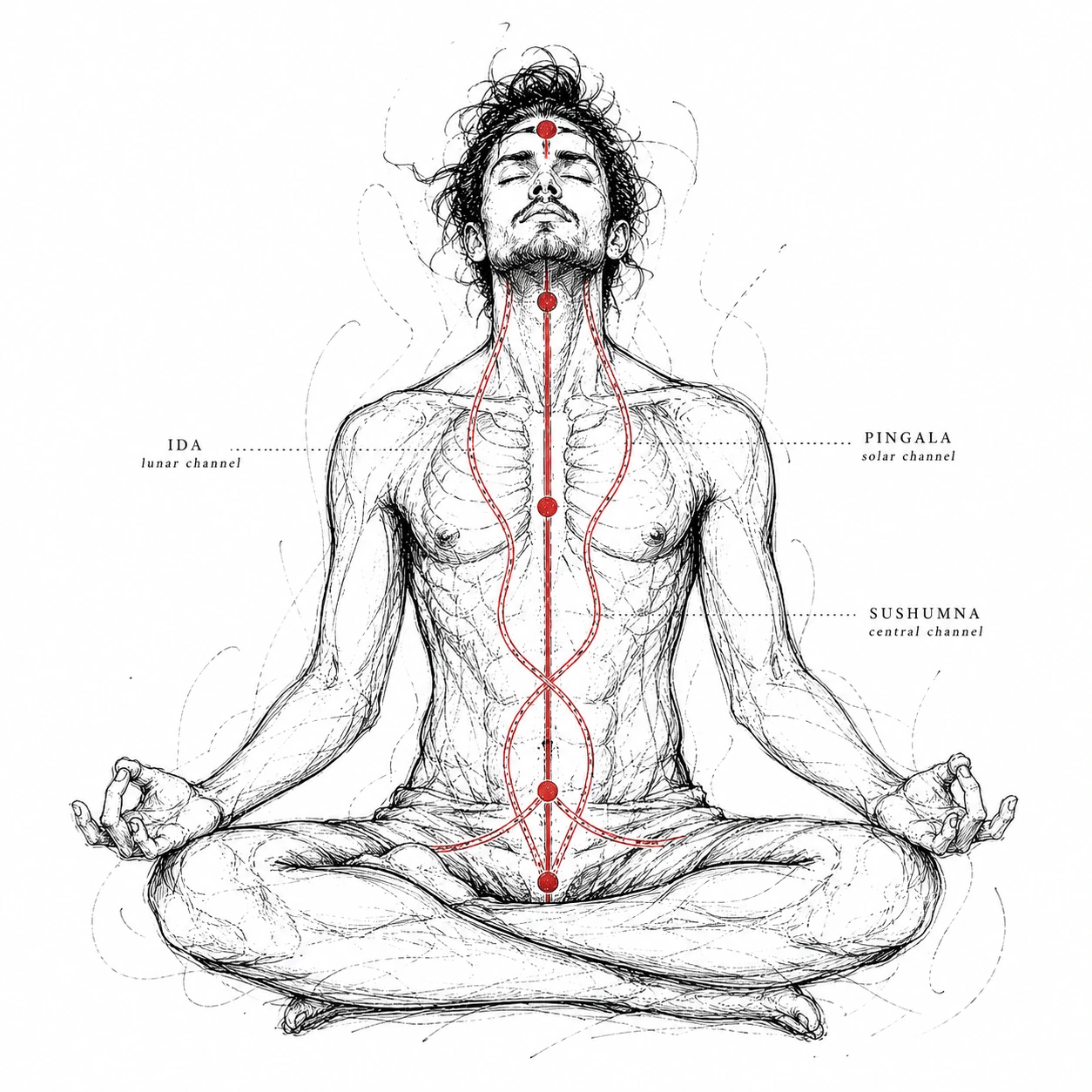
| Ida | Lunar / Feminine | Begins on the left side of the spine, associated with intuition, cooling energy, parasympathetic regulation, receptivity, and inward awareness |
| Pingala | Solar / Masculine | Begins on the right side of the spine, associated with vitality, action, heat, sympathetic activation, and outward expression |
| Sushumna | Central Channel | Runs through the spinal axis and represents spiritual integration, energetic ascent, and higher states of consciousness |
| Gandhari | Perception | Associated with the left eye and sensory processing |
| Hastijihva | Perception & Action | Associated with the right eye and coordinated activity |
| Pusha | Nourishment | Linked with digestion and assimilation |
| Yashasvini | Circulation | Associated with energetic distribution throughout the body |
| Alambusha | Elimination | Governs downward energetic movement and excretion |
| Kuhu | Reproduction | Connected with reproductive energy and generative functions |
| Shankhini | Internal Flow | Associated with fluid balance and internal energetic movement |
| Saraswati | Expression | Linked with speech, creativity, and communication |
| Payasvini | Nourishment & Fluids | Governs subtle nourishment and energetic support |
| Varuni | Water Regulation | Connected with fluid metabolism and purification |
| Vishvodhara | Integration | Associated with digestive fire and energetic balance |
Instead of seeing these two models as conflicting, it is more helpful to view them as two different languages describing the same human experience from unique perspectives. By integrating the wisdom of ancient energetics with the precision of modern neuroscience, we gain a more complete understanding of how our physical and subtle systems interact to define our well-being.
What Are Nadis?
In Sanskrit, the word nadi translates roughly as “stream,” “tube,” or “channel.” Yogic and Ayurvedic traditions describe a vast network of these subtle pathways carrying prana throughout the body. Classical texts often mention 72,000 nadis, while some traditions describe even more.
These channels are said to run alongside the physical structures of the body, interwoven with nerves, blood vessels, organs, and connective tissues. Their purpose is not the transmission of electrical impulses like nerves, but the movement of energetic vitality and regulation.
Ancient Sanskrit texts offer a detailed map of the human energetic anatomy, identifying a vast network of nadis (subtle channels) that carry prana (life force). While specific numbers vary across different scriptures, they consistently describe an intricate system that far exceeds the physical structures visible to the naked eye.
Many traditional sources, including the Hatha Yoga Pradipika and the Goraksha Samhita, state that there are 72,000 nadis in the human body. These channels originate from a central point known as the kanda, located just below the navel, and branch out to every part of the system. This number represents a symbolic and functional web, suggesting that every cell and pore is reachable by the flow of energy.
The three main Nadis
The Shiva Samhita, a foundational text of Hatha Yoga, provides an even more expansive view, mentioning that there are 350,000 nadis. Of this vast number, the text focuses on fourteen major channels, ultimately identifying three as the most critical for spiritual development:
- Ida: The lunar, cooling channel on the left.
- Pingala: The solar, heating channel on the right.
- Sushumna: The central channel through which the Kundalini energy ascends.
Regardless of the total number cited, yogic practice almost always centers on the three primary nadis that run alongside the spinal column. These channels serve as the foundation for Kundalini and Hatha Yoga systems, acting as the primary regulators for the entire 72,000 (or 350,000) channel network.
| Feature | Ida Nadi | Pingala Nadi | Sushumna Nadi |
|---|---|---|---|
| Polarity | Negative / Lunar | Positive / Solar | Neutral / Central |
| Quality | Cooling, Introversion | Heating, Extraversion | Balance, Equilibrium |
Ida Nadi: The Lunar Channel
The Ida Nadi, often called the “Moon Channel,” is the energetic pathway responsible for your body’s ability to rest, reflect, and recover. It originates at the base of the spine and travels to the left nostril, carrying a cooling, feminine energy.
- Biological Link: It acts as the energetic counterpart to the parasympathetic nervous system, triggering the “rest and digest” response to lower stress.
- Mental Function: This channel governs intuition, creative thinking, and the processing of emotions.
- Personality: Those with a natural Ida dominance tend to be nurturing, imaginative, and introspective, though they may sometimes struggle with being assertive.
- Attributes: It is associated with the color white, representing purity, clarity, and a receptive state of mind.
Pingala Nadi: The Solar Channel
The Pingala Nadi, known as the “Sun Channel,” is the energetic pathway for action, heat, and external focus. It starts at the base of the spine and travels up the right side to the right nostril, fueling the body with masculine, dynamic energy.
- Biological Link: It correlates with the sympathetic nervous system, the body’s “accelerator” that prepares you for effort, logic, and movement.
- Mental Function: This channel governs rational thinking, analytical processing, and your ability to interact with the world effectively.
- Personality: Those with dominant Pingala energy are typically assertive, productive, and physically vibrant. While this leads to high motivation, a heavy imbalance can sometimes lower qualities like empathy or receptivity.
- Attributes: It is associated with the color red, representing vigor, strength, and life force.
When this channel is balanced, you feel energized, focused, and capable of turning your ideas into reality.
The Sushumna Nadi: The Central Axis of Balance
The Sushumna Nadi is the most critical energy channel in the body, serving as the central highway for spiritual evolution. Running directly up the spine, it acts as the neutral bridge that harmonizes the polarities of the lunar (Ida) and solar (Pingala) energies.
- The Force of Integration: When prana enters Sushumna, the constant tug-of-war between logic and emotion or action and rest fades away. This creates a state of deep equilibrium, stillness, and internal harmony.
- Biological Parallel: In somatic terms, an active Sushumna represents a perfectly regulated nervous system—one that is neither stuck in “fight or flight” nor “freeze,” but is present, centered, and resilient.
- The Path of Awakening: Sushumna is the only channel capable of safely carrying Kundalini energy as it rises from the base of the spine to the crown. This ascent is what leads to expanded awareness and a profound sense of universal connection.
Practicing with an Active Sushumna
When you feel this central channel open, often experienced as a sense of “verticality,” deep peace, or a humming centeredness, it is a sacred window for high-level regulation and connection. During these moments, focus on:
- Stillness & Meditation: Utilizing the natural quiet of the mind to go deeper into the “witness” state.
- Chanting & Prayer: Directing the balanced energy toward intentions, blessings, and healing for yourself and others.
- Gentle Integration: Practicing restorative yoga or slow movement to ground the heightened frequency into your physical cells.
Sushumna is the “middle way.” While Ida and Pingala navigate the world of dualities, Sushumna is the path to your true, unshakable nature.
Kanda and Yukta Triveni
Kanda and Yukta Triveni are the foundation and the confluence of our vital life force. These structures serve as the “ground zero” for the movement of prana and the potential for spiritual evolution.
The Kanda: The Source of Prana
The Kanda is a bulb-like structure located just below the Muladhara (Root) Chakra at the base of the spine. Often described as a small, oval-shaped reservoir, it is the primary storehouse of dormant energy.
- Dormant Potential: It is the traditional “nest” where the Kundalini, or coiled serpent energy, resides before awakening.
- Distribution Center: Beyond storage, the Kanda acts as a central hub responsible for distributing vital energy through the vast network of 72,000 (or 350,000) nadis.
Yukta Triveni: The Combined Streams
The three primary energy channels, Ida, Pingala, and Sushumna, all originate from a specific point within the Kanda called the Yukta Triveni.
- The Name: In Sanskrit, Yukta means “combined” and Triveni refers to “three streams.”
- The Launchpad: This is the singular point of origin where the lunar (Ida), solar (Pingala), and central (Sushumna) energies are unified before they begin their distinct paths up the spinal axis.
Mukta Triveni: The Point of Liberation
While the streams begin together at the base, they meet again at the Mukta Triveni, situated at the Ajna (Third Eye) Chakra.
- Harmonious Balance: When prana from the three channels merges at this point, it symbolizes the perfect union of feminine (lunar) and masculine (solar) energies.
- Spiritual Awakening: This convergence is believed to dissolve the sense of duality, clearing the path for spiritual awakening and the experience of self-realization.
14 major nadis
Traditional texts identify 14 major nadis that serve as the primary conduits for our energetic and physiological functions. While there are thousands of channels in the body, these 14 are considered the most significant for balancing our spiritual and physical health.
| Nadi Name | Path (Origin to Termination) | Primary Function |
|---|---|---|
| Sushumna | Kanda to Sahasrara (Crown) | The central channel; the path of spiritual awakening. |
| Ida | Left Kanda to Left Nostril | The lunar channel; governs emotions, restoration, and intuition. |
| Pingala | Right Kanda to Right Nostril | The solar channel; governs logic, heat, and physical action. |
| Gandhari | Left Eye to Left Big Toe | Supports Ida; regulates visual and lower-body energy. |
| Hastijihva | Right Eye to Left Big Toe | Facilitates energy movement between the upper and lower body. |
| Yashaswini | Right Big Toe to Right Ear | Distributes energy to the limbs on the right side of the body. |
| Pusha | Left Big Toe to Right Ear | Supports Pingala; maintains ear and solar balance. |
| Alambusha | Anus to Mouth | Energizes the organs responsible for waste elimination. |
| Kuhu | Throat to Genitals | Governs reproductive energy and sexuality. |
| Saraswati | Tongue to Right Ear | Energizes the tongue, throat, and speech. |
| Payaswini | Right Kanda to Right Ear | Complementary to Pingala; regulates ear health. |
| Shankhini | Throat to Anus | Runs along the left side of Sushumna; supports systemic flow. |
| Varuna | Muladhara to Anahata | Distributes energy to the entire body and the nervous system. |
| Vishvodhara | Muladhara to Manipura | Focuses energy specifically on the digestive system. |
The three knots
Granthis (Sanskrit for “knots”) describes specific energetic blockages within the subtle body. These knots sit along the Sushumna Nadi (the central channel) and act as functional barriers that prevent Kundalini energy from rising toward the crown.
Psychologically and somatically, these knots map remarkably well onto layered patterns of survival, emotion, and perception.
1
Brahma Granthi: The Knot of Survival
Located at the base of the spine near the Muladhara (Root) Chakra, this first knot is tied to our most primal instincts.
- The Blockage: Attachment to physical security, material desires, and the fear of death.
- How it Manifests: Chronic insecurity, a “scarcity mindset,” or a rigid focus on survival.
- The Shift: Piercing this knot establishes grounded stability independent of external circumstances.
2
Vishnu Granthi: The Knot of Emotion
Situated in the heart region near the Anahata (Heart) Chakra, this knot governs our emotional identity.
- The Blockage: Conditional love, ego-driven relationships, and the need for societal approval.
- How it Manifests: Emotional turbulence—jealousy, possessiveness, or intense attachment to identity.
- The Shift: Dissolving this knot allows for universal compassion and non-transactional love.
3
Rudra Granthi: The Knot of Perception
Residing at the Ajna (Third Eye) Chakra, this final knot is the barrier between the individual ego and universal consciousness.
- The Blockage: Attachment to mental concepts, dogmas, and the “intellectual ego.”
- How it Manifests: Mental confusion, lack of purpose, or inability to see past subjective reality.
- The Shift: Leads to a state of non-duality and direct experience of higher consciousness.
To reach a state of full spiritual and physical evolution, these energetic knots, the Granthis, must be unraveled. While the destination is the same, the “technology” used to get there varies significantly between traditional yoga and the more biological approach of somatic shaking.
Traditional Yoga: The Disciplined Path
In classical yogic philosophy, unblocking these energies is a deliberate, often slow-moving process. It relies on internal precision and spiritual discipline to “melt” the knots over time.
- Pranayama: Using specific breath ratios to build internal heat and pressure.
- Mantras & Mudras: Utilizing sound frequencies and hand gestures to resonate with specific energy centers.
- Asanas: Holding physical postures to stretch the “containers” of these knots.
- Meditation: Focused awareness to observe and eventually dissolve mental and emotional attachments.
Somatic Shaking: The Biological “Reset”
Somatic shaking works because The Shake Effect bypasses the analytical mind, communicating directly with the body’s survival architecture.
Many of us try to find calm by sitting still, but Somatic Shaking understands that some tension is simply too deep for stillness to reach. We treat stress as a mechanical reality, a physical ‘grip’ on your nervous system. Through rhythmic vibration, we move beyond basic relaxation to physically shake tension out of your fascia and muscles, finally releasing that old survival energy.
Until next time… Shakers, Keep The Vibe Alive!
That Shakin' Guy