Five Elements Theory: The Ancient Map to Balance, Power, and Inner Mastery
The Five Elements Theory is one of the most sophisticated psychological, energetic, and philosophical models ever created to understand human nature, life cycles, and transformation. Rooted in ancient Eastern wisdom, this system remains strikingly relevant in a modern world overwhelmed by stress, disconnection, and imbalance.
At its core, the Five Elements Theory explains how energy moves, transforms, and expresses itself—in nature, in the body, in emotions, and in consciousness.
When you understand it, you stop fighting life. You start working with it.
What Is the Five Elements Theory?
The Five Elements Theory originates from ancient Chinese philosophy and Taoist thought, forming the backbone of traditional systems such as Chinese medicine, martial arts, feng shui, and spiritual cultivation.
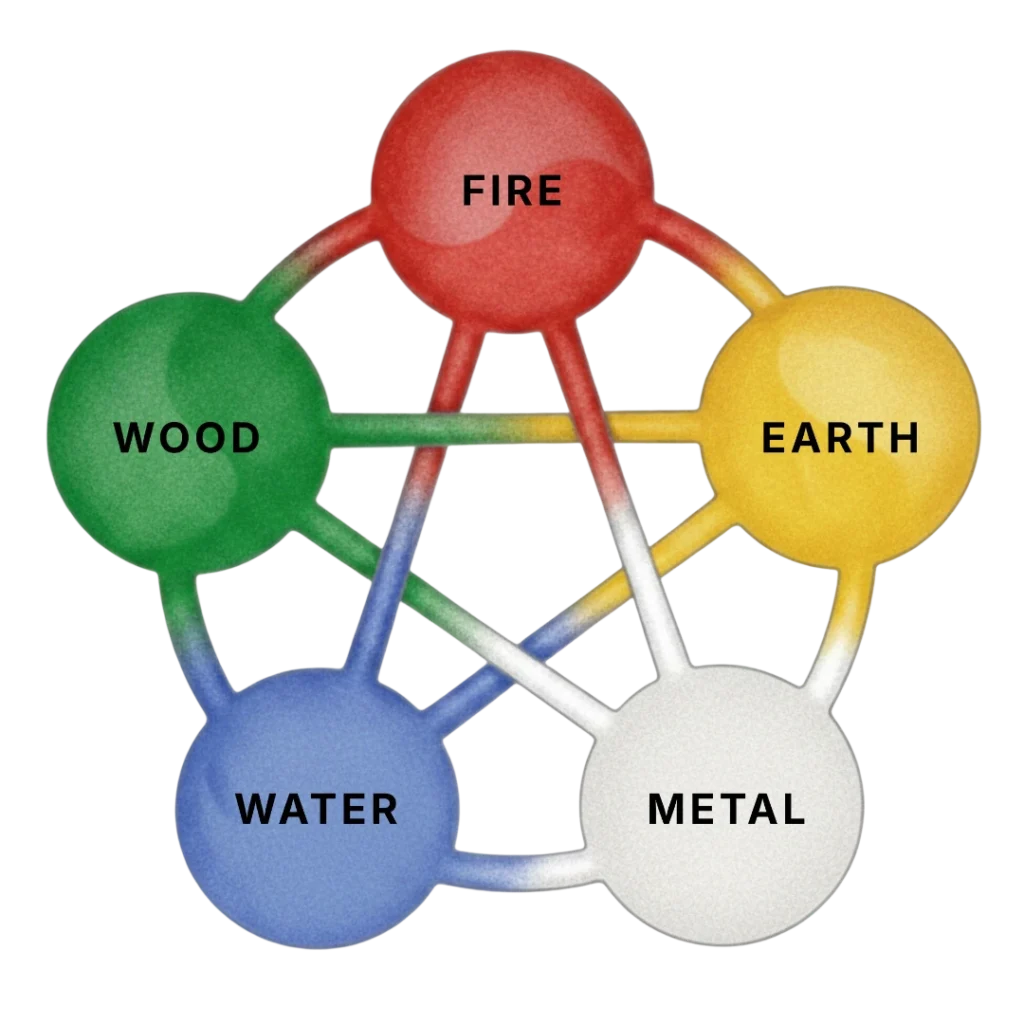
The five elements are:
These are not literal substances. They are archetypal forces, representing patterns of movement, emotion, growth, decay, and renewal.
Every experience in your life, success, burnout, love, fear, clarity, confusion, can be traced back to how these elements interact within you.
The Five Elements Explained
1. Wood — Vision, Growth, Direction
Wood represents expansion, ambition, creativity, and forward movement.
Psychologically, it governs:
Balanced Wood energy feels like:
Clear direction
Healthy motivation
Calm assertiveness
Excess or deficiency shows up as:
Wood asks: Where am I growing, and what is blocking me?
2. Fire — Joy, Expression, Vitality
Fire is life force in motion. It rules connection, passion, intimacy, and authentic expression.
Emotionally, Fire governs:
Joy and enthusiasm
Love and intimacy
Presence and charisma
Spiritual inspiration
Balanced Fire energy feels like:
Warmth
Emotional openness
Natural confidence
Imbalanced Fire appears as:
Fire asks: Am I alive—or just surviving?
3. Earth — Stability, Nourishment, Safety
Earth is the center. It represents grounding, support, and integration.
Earth energy governs:
Balanced Earth feels like:
Calm stability
Trust in life
Emotional resilience
Imbalance shows as:
Overthinking
Worry
People-pleasing
Emotional exhaustion
Earth asks: Do I feel supported—by myself and by life?
Metal is the element of discernment, structure, and truth.
Psychologically, Metal governs:
Boundaries
Grief and loss
Integrity
Self-respect
Balanced Metal feels like:
Clean emotional space
Strong boundaries
Inner dignity
Imbalance manifests as:
Rigidity
Emotional suppression
Inability to let go
Chronic sadness
Metal asks: What must I release to move forward?
5. Water — Depth, Fear, Wisdom
Water is the deepest element. It represents intuition, survival, rest, and ancestral memory.
Water governs:
Balanced Water feels like:
Inner stillness
Deep confidence
Natural flow
Imbalance appears as:
Chronic fear
Exhaustion
Burnout
Loss of purpose
Water asks: Do I trust life—or am I constantly bracing against it?
The Cycle of Balance: How the Elements Work Together
The Five Elements move in a continuous cycle:
Wood feeds Fire
Fire creates Earth
Earth forms Metal
Metal enriches Water
Water nourishes Wood
When one element is ignored, overstressed, or suppressed, the entire system destabilizes.
This is why symptoms rarely exist alone, emotionally or physically.
Why the Five Elements Theory Matters Today
Modern culture glorifies:
Constant productivity (excess Fire)
Endless growth (overdriven Wood)
Emotional suppression (blocked Metal)
And ignores:
Rest (Water)
Integration (Earth)
The result?
Burnout. Anxiety. Disconnection. Loss of meaning.
The Five Elements Theory doesn’t promise quick fixes.
It offers self-mastery through awareness.
Applying the Five Elements to Daily Life
You can use this system to:
Understand emotional patterns
Regulate your nervous system
Improve relationships
Align work with your natural rhythm
Build sustainable energy—not forced discipline
This is not spirituality for escape.
It is wisdom for embodiment.