Let's Shake Hands: Free Connection Call 

Roots And Traditions of Shaking
Table of Contents
SHAKING ROOTS AND TRADITIONS: A GLOBAL ARCHIVE
I. Nature — The Biological Foundation
Instinctive Mammalian Tremoring
Across the animal kingdom, mammals instinctively tremor after stress, threat, or intense activation. This shaking discharge restores autonomic balance and maintains homeostasis.
Modern somatic frameworks often reference this biological reset as the primal template for human shaking practices.
II. Indigenous & Ancient TraditionsModern somatic frameworks often reference this biological reset as the primal template for human shaking practices.
Kalahari Bushmen (San People – Southern Africa)
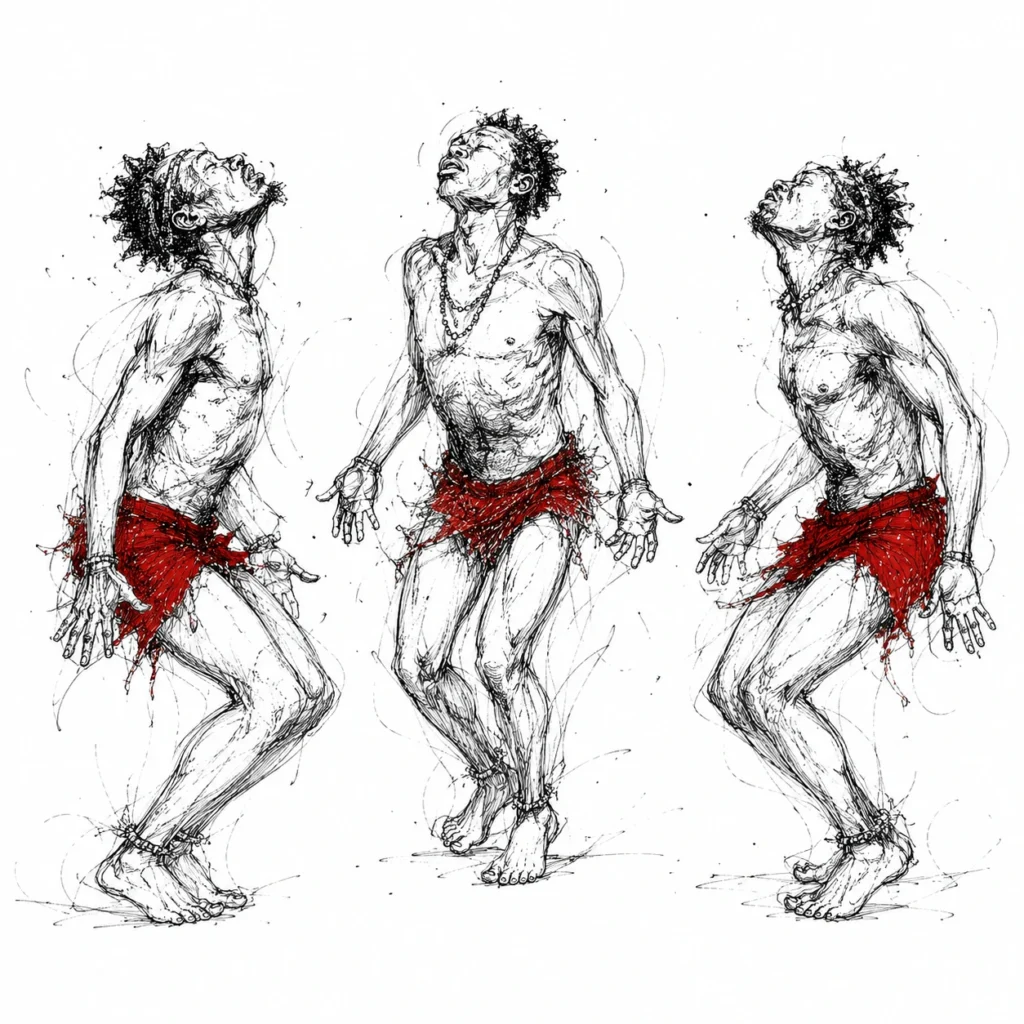
The San practice ecstatic trance dances involving rhythmic movement, shaking, trembling, and altered states to activate healing energy (n/um). Anthropologists regard them as one of the oldest continuous shamanic cultures on Earth (estimated 40,000–60,000+ years).
Shaking Tent Ceremony (North America)
Among Algonquian and other Indigenous peoples, spiritual leaders conduct “shaking tent” rituals where the tent physically trembles, symbolizing spiritual presence and energetic activation.
Australian Aboriginal Ceremonial Movement
Ritual dances including intense rhythmic movement, stamping, vibration, and trance states for spiritual alignment and community healing.
Japanese Seiki & Martial Traditions
Seiki Jutsu (Akinobu Kishi lineage) encourages spontaneous movement. Samurai martial training historically included vibrational practices and breath-based activation.
III. Taoist Internal Energy Practices
Neidan, Qi Gong & Zi Fa Gong
Internal Alchemy (Neidan) and Zi Fa Gong (Spontaneous Qigong) involve "self-arising skill"—spontaneous shaking and movement without imposed structure as qi reorganizes.
IV. Indian Yogic & Tantric Lineages
Tantra, Kriya & Kundalini Yoga
Awakening kundalini through breath and movement; spontaneous shaking (Kriyas) arises during energetic release to clear blockages.
Osho (Bhagwan Shree Rajneesh)
Systematized shaking through Dynamic Meditation and Kundalini Meditation as tools for emotional detox and energetic clearing.
V. Indonesian & Southeast Asian Practices
Ratu Bagus & Latihan Kejiwaan (Subud)
Bio-Energy Shaking for emotional purification and spontaneous spiritual exercises emerging from inner guidance rather than technique.
VI. European Ritual & Folk Traditions
Călușari (Romania)
Ancient ritual dance featuring rhythmic stamping and trance-like states associated with embodied communal cleansing and spiritual activation.
VII. Christian & Biblical Contexts
Shakers, Quakers & Pentecostal Traditions
Ecstatic worship involving trembling and shaking under divine inspiration. Historical references to "quaking before the Lord" as a bodily expression of spiritual intensity.
VIII. Martial & Shamanic Parallels
Warrior Activation
Rhythmic movement and tremoring used globally to prepare for battle, enter trance, and cleanse fear.
IX. Thematic Threads
Core Patterns
• Tremor as discharge
• Movement before stillness
• Ecstasy as purification
• Community ritual as healing container
• Movement before stillness
• Ecstasy as purification
• Community ritual as healing container
INVOLUNTARY SHAKING IN BUDDHIST MEDITATION
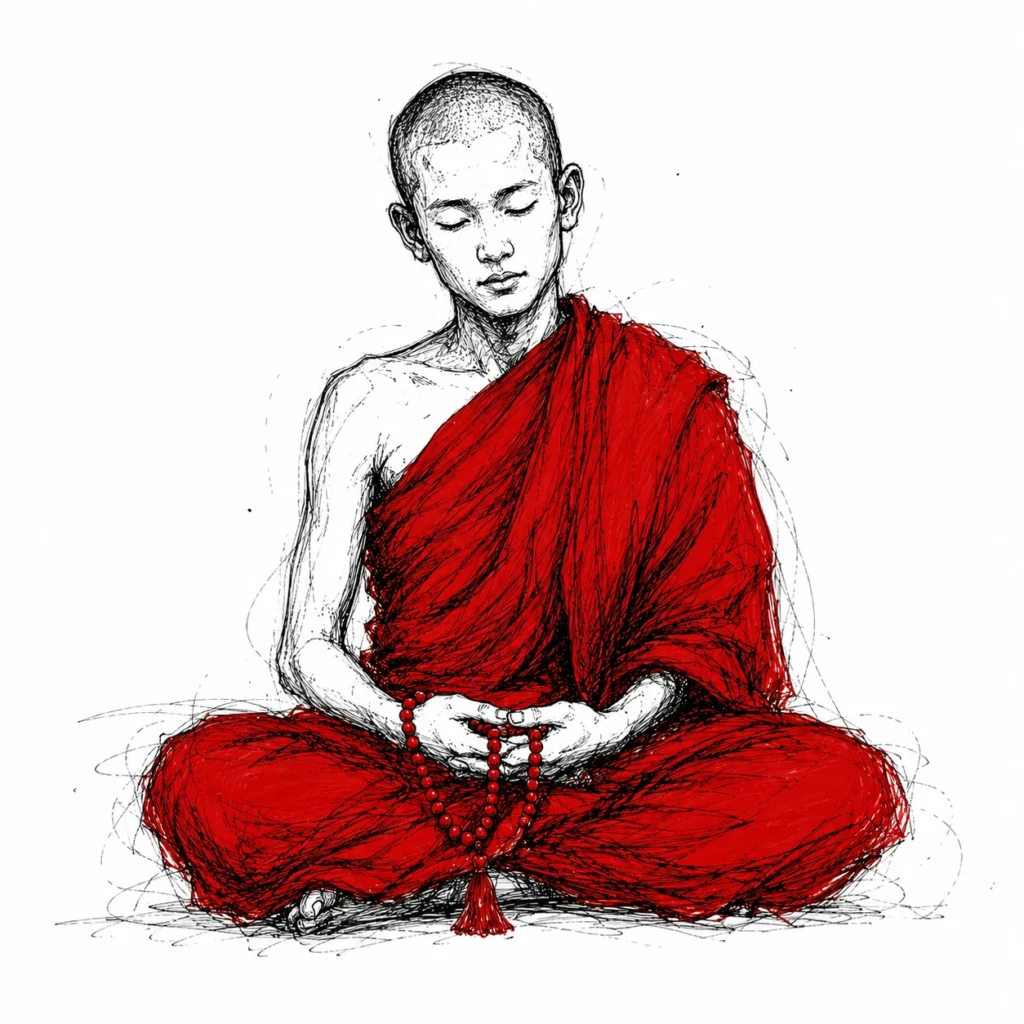
In the early Buddhist texts, one of the clearest references to bodily shaking appears in SN 54.7, the Mahākappina Sutta, where the Buddha points to a meditator whose body and mind show no visible disturbance, shaking, or trembling. The passage is important because the absence of shaking is presented as the fruit of deeply cultivated mindfulness of breathing as concentration, rather than as muscular control, suppression, or spiritual performance.
The solution offered by the text is not to fight the tremor directly, but to develop a level of breath-based samādhi that gradually settles the nervous system, stabilizes attention, and allows the body to become quiet from within. This is why SN 54.7 matters for Somatic Shaking™: it suggests that involuntary movement can belong to a continuum of practice, where the body first reveals disturbance, pressure, or energetic unevenness before deeper regulation and stillness become available.
The larger discipline around this process is also reflected in AN 3.16, the Apaṇṇaka Sutta, where the Buddha describes three qualities that support liberation: guarding the sense doors, eating in moderation, and being devoted to wakefulness. The text places practice within the rhythm of walking and sitting meditation, which suggests that transformation depends on a whole way of living, not merely on isolated moments of technique.
From an expert somatic perspective, involuntary shaking in meditation can be understood as the meeting point between attention, relaxation, stored tension, and rising internal pressure. When the body becomes still enough and the mind becomes concentrated enough, unresolved muscular holding, autonomic activation, fascial restriction, or what some traditions call energetic obstruction may become more visible. The shaking is often the body trying to reorganize itself under the pressure of increased awareness.
Some modern practitioners describe this phenomenon through the language of energy channels, microcosmic orbit, internal pressure, or what they call “jhana force.” This is interpretive language rather than a direct doctrinal statement from the early Buddhist texts, yet it points toward a real experiential pattern: as meditation deepens, some parts of the body may feel open, fluid, warm, or spacious, while other areas may feel blocked, pressured, restless, painful, or vibratory. This unevenness can produce visible shaking or subtle internal trembling.
The phrase jhana constipation is a modern informal term used by some practitioners to describe the feeling of meditative energy building up while the body remains constricted. In this view, first jhāna may be close in principle, yet its pleasure and ease are not fully felt because the body cannot distribute the force smoothly. The early Buddhist simile in AN 5.28 describes the body being pervaded by rapture and pleasure, which gives us a useful contrast: mature concentration feels integrated, while immature concentration may feel uneven, agitated, or physically turbulent.
Lifestyle also matters. The monastic model assumes restraint, celibacy, moderation, sense discipline, sufficient wakefulness, and many hours of walking and sitting meditation. A lay practitioner living with constant overstimulation, insufficient sleep, sexual depletion, emotional stress, mental rumination, and occasional practice may experience the same process more slowly and with less stability. The body’s capacity for stillness is shaped by the life that surrounds the meditation.
Somatic Shaking™ can hold this discussion in a practical way. In Buddhist breath meditation, the long arc of practice may lead toward the calming of bodily and mental trembling through samādhi. In somatic work, shaking can also be used deliberately as a transitional process, allowing the nervous system to discharge tension, soften defensive holding, and return toward coherence. The two approaches move differently, yet both recognize that the body must participate in the path from agitation toward steadiness.
This is the essential bridge: shaking may appear when the body is reorganizing under attention. Sometimes the answer is more breath, more patience, more walking meditation, more ethical restraint, and more nervous system stability. Sometimes the answer is allowing the tremor to complete in a safe somatic container. In both cases, the movement is meaningful because it belongs to the body’s attempt to move from pressure into flow, from fragmentation into integration, and from unconscious holding into embodied presence.
shaking as a ritual dance in europe
Across Europe, there are old movement traditions in which the body does not simply dance for beauty, entertainment, or performance. It stamps, jumps, turns, strikes, shakes, and organizes itself through rhythm, often inside a ritual frame that connects the community with healing, protection, fertility, warrior memory, seasonal transition, and sacred presence. Two powerful examples are the Romanian Călușarii and the Portuguese Pauliteiros de Miranda.
The Călușari tradition, preserved especially in southern Romania and recognized by UNESCO as part of the intangible cultural heritage of humanity, is more than a folk dance. It carries the structure of an old ritual complex: male dancers, collective discipline, fast footwork, jumps, bells, sticks, music, symbolic gestures, and a strong association with purification, protection, vitality, and the restoration of social and bodily order.
Seen through a somatic lens, the Călușari rhythm is fascinating because the body is constantly brought into intensity through repetition, impact, acceleration, coordination, and collective entrainment. The dancer does not remain in a private psychological state; he is carried by the group, by the music, by the bells, by the floor, by the stick, and by the inherited ritual form. In this sense, movement becomes a technology of transformation, where the nervous system is reorganized through rhythm, exertion, sound, and symbolic action.
The Portuguese Pauliteiros de Miranda, from the Miranda do Douro region, offer another striking example of ritualized movement using sticks. This tradition is often described as a stick dance and has also been historically associated with older sword-dance forms, carrying elements that can be read as warrior-like, religious, communal, and ceremonial. The dancers strike wooden sticks in precise rhythms while moving in formation, creating a percussive choreography where sound, timing, masculine coordination, and collective force become one embodied language.
What links these traditions is not identical origin, but a shared archaic intelligence: the body enters rhythm in order to change state. The striking of sticks, the stamping of feet, the jumps, the turns, the bells, the breath, and the repetition all create a field in which the individual nervous system is no longer isolated. The body is placed inside a collective rhythm, and that rhythm begins to regulate, intensify, charge, discharge, and reorganize the group.
This is where the parallel with Somatic Shaking™ becomes meaningful. In Somatic Shaking™, tremor and rhythm are used to help the nervous system release accumulated tension and return toward coherence. In traditions like Călușarii and Pauliteiros de Miranda, movement appears inside a cultural and ritual body, where shaking, stamping, striking, jumping, and repetition serve as communal forms of activation, protection, and renewal. The language is different, yet the principle is familiar: the body knows how to transform pressure through movement.
Long before movement was reduced to exercise, performance, or aesthetics, it served as medicine, prayer, initiation, purification, and social repair. These traditions remind us that the body has always carried ancient methods for changing state, clearing stagnation, restoring vitality, and reconnecting the person to something larger than the individual self.
JEWISH SHUCKLING
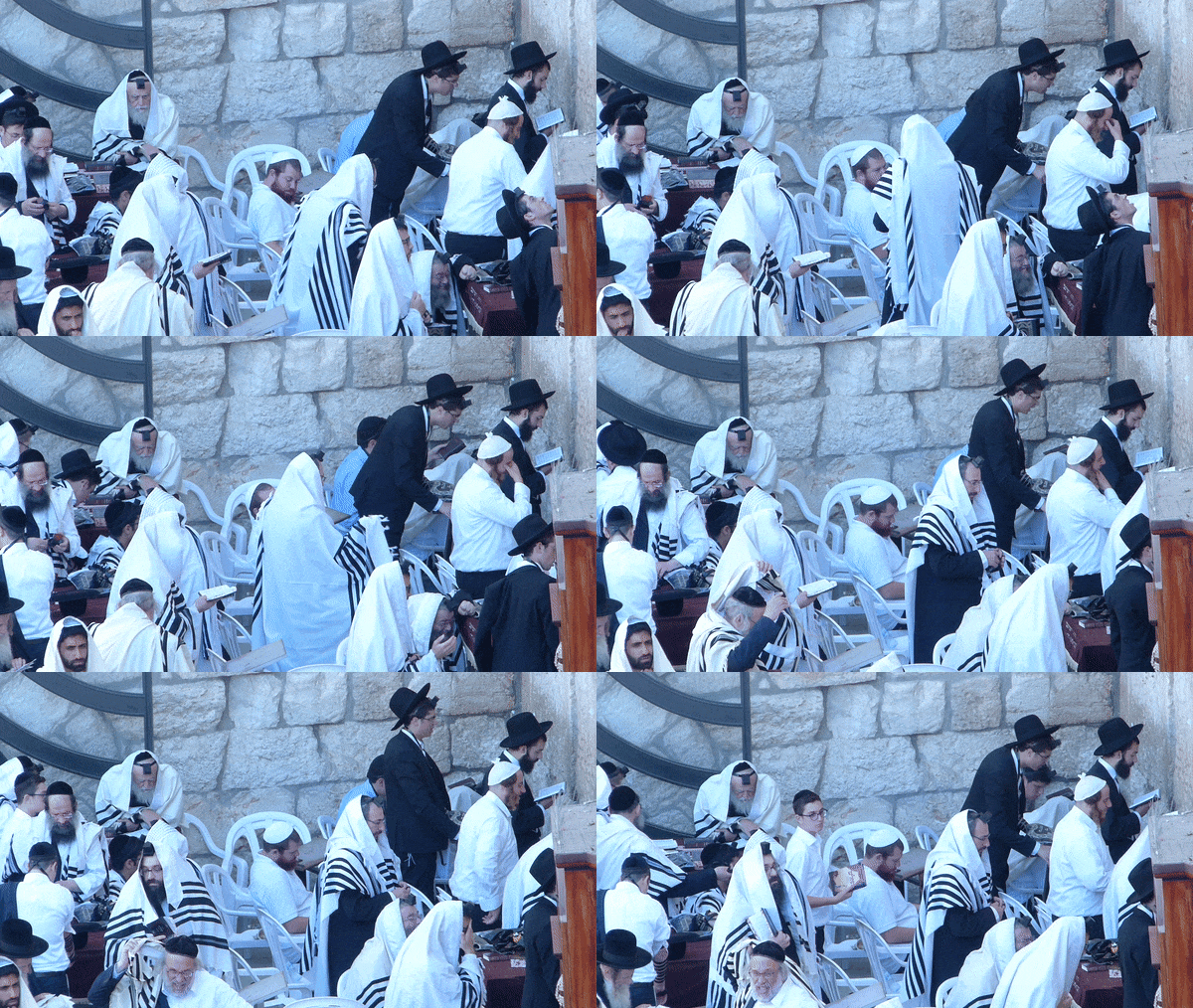
In Jewish tradition, one of the most recognizable forms of embodied prayer is known as shuckling, also written as shokeling, a Yiddish term used for the rhythmic rocking, swaying, or subtle shaking of the body during prayer and Torah study. At the Western Wall in Jerusalem, this movement becomes especially visible: bodies leaning toward ancient stone, lips moving through sacred words, breath and memory gathered into a continuous devotional rhythm.
From a somatic perspective, shuckling reveals an old and refined understanding of prayer as an event of the whole organism. The practitioner engages more than language or thought; the spine, breath, gaze, voice, bones, attention, and inner longing enter the act of worship, transforming prayer into a lived physical experience rather than a purely mental discipline.
Traditional explanations often connect this movement with the idea that all the bones should praise God, suggesting that devotion belongs to the entire body and that sacred attention can be expressed through rhythm, posture, breath, and movement. Other Jewish teachings describe swaying as a way of deepening kavannah, the focused inner intention of prayer, allowing the body to support concentration during long periods of worship or study.
A more mystical interpretation compares the soul to a flame. A flame flickers, bends, rises, and trembles as it reaches upward, and shuckling carries a similar image: the body moves because the soul is reaching toward its source. In this view, the rhythm of the body mirrors the movement of devotion itself, where the human being oscillates between earth and spirit, form and longing, silence and expression.
Seen beside Somatic Shaking™, shuckling should be approached with respect for its Jewish religious context, while still recognizing the wider human pattern it reveals. Across traditions, when people enter prayer, grief, surrender, reverence, study, or longing, the body often begins to organize itself through rhythm. Sometimes that rhythm appears as trembling, sometimes as swaying, sometimes as rocking, bowing, breath, sound, or stillness.
The deeper point is simple and profound: the body has always belonged to spiritual practice. Long before movement was treated as fitness or performance, it served as a bridge between inner experience and outer expression, between the nervous system and devotion, between what the heart carries in silence and what the body finally begins to release.
EAST-WEST PARALLELS
There is a deeper parallel here that I personally find impossible to ignore. The English word shake comes through Middle English from Old English sceacan, meaning to move rapidly back and forth, to tremble, to cause vibration, or to move the body in quick oscillation. Its reconstructed Proto-Germanic root, skakanan, carries the sense of shaking, swinging, shifting, and movement, while some etymological discussions also connect it more broadly with ancient ideas of jumping, stirring, agitating, or moving through space.
The Hebrew word Shekinah, however, comes from a different linguistic world. It is derived from the Hebrew root shakan, meaning to dwell, settle, abide, or rest, and it is traditionally used to speak about the indwelling or manifest presence of God. The same root also appears in related words such as mishkan, the dwelling place or Tabernacle, which gives the term a powerful sense of sacred presence taking residence within a place, a people, or a body.
I do not present these roots as a proven linguistic cognate, because English and Hebrew belong to different language families and the historical evidence points in different directions. Yet as a somatic and spiritual parallel, the resemblance is deeply meaningful: shake speaks of movement, trembling, vibration, and embodied disturbance, while shakan speaks of dwelling, settling, resting, and divine presence. Together, they suggest a profound movement from agitation into inhabitation, from vibration into presence, from the body in motion into the body as a sacred dwelling place.
This is why shuckling at the Western Wall becomes so interesting when seen through the lens of Somatic Shaking™. The body rocks, sways, trembles, and repeats a devotional rhythm, while the practitioner stands before a place associated with memory, prayer, covenant, and divine nearness. The movement is not merely physical; it becomes a way of entering presence through rhythm, as if the body must first move in order to become a vessel capable of holding what is sacred.
My belief is that the roots of these practices touch the same ancient human intelligence. The body shakes, sways, bows, trembles, breathes, and sounds until something deeper begins to settle. In that sense, the real mystery is not only that the body moves, but that movement can become a doorway into dwelling. Shaking becomes a passage into presence, and presence becomes the place where the nervous system, the heart, and the sacred can finally meet.
Until next time… Shakers, Keep The Vibe Alive!
That Shakin' Guy

Adrian Băjenaru
Somatic Shaking™ Method Founder • Neurogenics & Bioenergetics