Let's Shake Hands: Free Connection Call 

The Shaking Tent Ceremony: From Ancient Cree Wisdom to Modern Somatic Release
Table of Contents
The Mystery of the Shaking Tent: A Primal Connection
The image is iconic: a solitary tent in the Canadian wilderness, vibrating with an energy that seems to defy physics. To the Cree, Innu, and Ojibwa, the Shaking Tent Ceremony (or Kosapachikan) was the ultimate threshold between the human and spirit worlds. But beyond the historical accounts lies a profound truth about the human nervous system and our ancient need to “shake out” the invisible.
What is the Shaking Tent Ceremony?
The Sacred Vessel
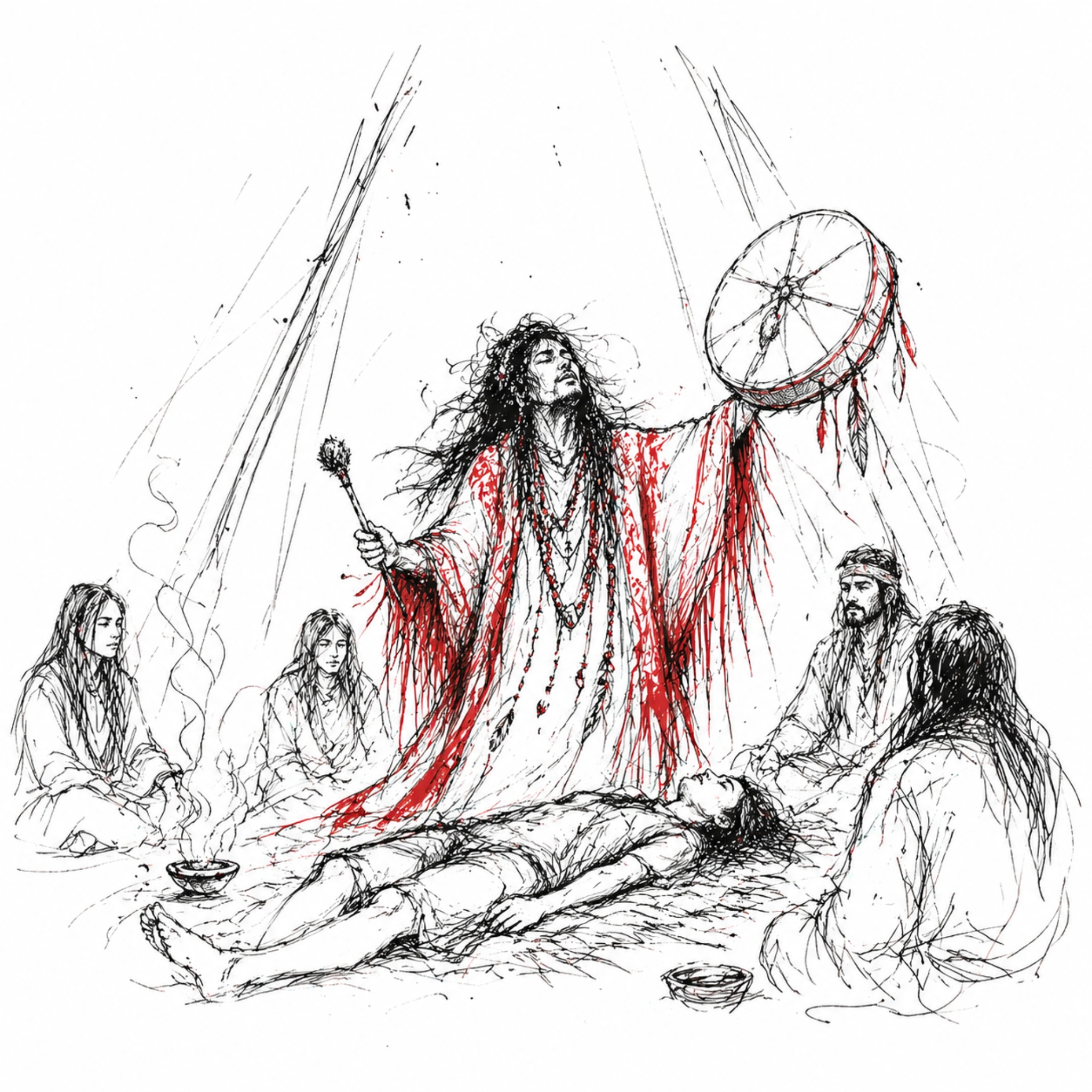
Historically, the ceremony was a masterclass in shamanic authority. A shaman would enter a specially constructed, barrel-shaped lodge. Through chanting, dreaming, and prayer, they would summon spirits—manifested by the violent shaking of the tent poles.
The ceremony begins with a deliberate, careful preparation. The lodge is not a simple shelter, but a sanctuary built with intention, usually from eight or more poles of birch or cedar. These “bones” of the tent are driven deep into the earth, anchoring the structure to the ground, while hoops bind them together to create a solid, immovable frame.
Once the frame is ready, it is shrouded in caribou skins or birch bark, creating a space of absolute darkness and silence inside. This is what we call a “clean container”, a place where the distractions of the outside world fade away, and the practitioner is left alone with their own presence and the energy of the earth.
The Shaking Tent Ceremony is practiced mainly by the Cree in Canada. Although modern Cree religious life has been strongly influenced by Christian missionaries, important elements of traditional belief remain.
These include belief in a Great Spirit, often called Kitchi Manitou, and in an evil spirit, Matchi Manitou, who may need to be placated to prevent illness and social disorder. In this context, the shaking tent remains one of the most important expressions of Cree religious life, used for healing, guidance, and communication with the spirit world.
The Shaking Tent.
To witness the ceremony is to witness something that seems to defy ordinary explanation. Once the shaman enters the darkened tent and begins to pray, the structure itself starts to sway and tremble, sometimes with startling force.
To the people who observed it, this was not just movement in the canvas and poles; it was a sign that spirits had arrived and that communication with the unseen world was underway. To the elders, this shaking was the physical sign of the Manitou (spirits) arriving to offer healing and guidance.
The shaking tent functioned as a sacred meeting place where questions could be answered, illnesses addressed, and lost things or people sought. The ceremony was often prepared through fasting, prayer, and sometimes a sweat lodge, which emphasized discipline, focus, and spiritual readiness. Some early descriptions and later ethnographic accounts also note that the shaman could appear exhausted afterward, suggesting the ritual demanded intense physical and mental endurance.
What makes the ritual so powerful is that it joins the physical and the spiritual. The tent’s violent movement becomes the outward sign of an inward encounter, transforming a simple structure into what participants understood as a bridge between human beings and the spirit world.
In Spirit Lodge: A North American Shamanistic Séance, Åke Hultkrantz treats the ceremony as a form of shamanism oriented toward divination, in which trance, spirit presence, and the physical movements of the lodge belong to the same ritual event. Hallowell notes clearly that the lodge trembled strongly, swayed, and at times seemed on the point of collapse, suggesting an intensity that, for witnesses, exceeded purely mechanical explanation.
Here are a few elements described in that session:
The tent begins to shake violently.
The conjurer may be tied up inside the tent.
Voices other than the conjurer’s are heard.
The conjurer emerges exhausted.
In John M. Cooper’s 1944 study, The Shaking Tent Rite among Plains and Forest Algonquians, the rite is presented as a ritual in which the diviner is sometimes bound or otherwise immobilized inside the tent, while the tent itself begins to shake with striking force. The visible movement of the lodge is not treated as incidental; it is one of the central features of the ceremony and is part of what gives the ritual its power and credibility.
In The Knowledge Seeker: Embracing Indigenous Spirituality, Blair Stonechild reflects a modern Indigenous view where the shaking is not a physical act, but a form of communication with the spirit world. The movement is understood as something that arises through connection—an interaction with the unseen, not a performance of the body.
Early eyewitness accounts reinforce the same pattern. Samuel de Champlain, writing in the 1600s, described how “the lodge shakes and moves violently,” while “voices and sounds are heard from within.” In these early reports, the phenomenon is not framed as a physical performance, but as something happening through the space itself—an event marked by movement and disembodied sound rather than visible bodily effort.
Similar Balinese Practices
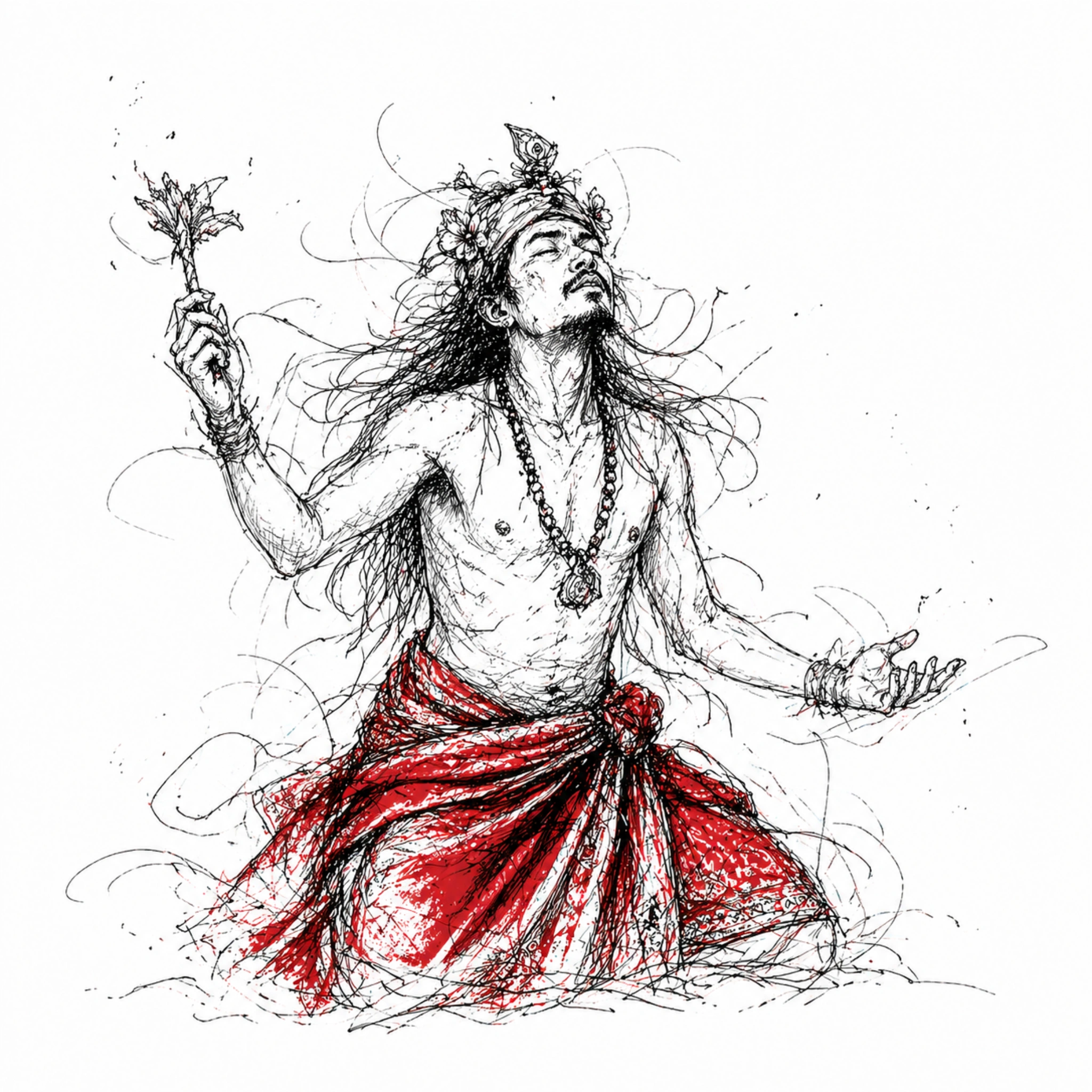
In Balinese ritual practices, especially in trance states known as kerauhan (spirit possession), the movement of the body is not self-generated. It’s seen as the result of spirit interaction, very similar in logic to the shaking tent, just embodied instead of externalized.
A clear example is described in the Balinese Religion and Society by Clifford Geertz:
“The dancer is said not to be himself but to be entered by a spirit, which then directs his movements.”
Living in Bali for the past few years, I can say these practices are quite common among locals. Spirit possession is often understood as a way to heal illness or to help make wishes come true, and there is usually a sense of exchange or agreement involved. That said, my own path is different: I work with neurogenic shaking in the body, and that process is not facilitated by external spiritual forces. I’ve also seen ceremonies where people begin trembling seemingly out of nowhere, and within the local framework this is understood as a spirit taking hold of the body.
My experience, however, is more internal and somatic, focused on the body’s own nervous system discharge rather than possession or trance. In more advanced stages, experiences such as kundalini awakening, shamanic trance, and other altered states may arise, often resembling the kinds of phenomena described by people using sacred plants in psychedelic journeys.
The Somatic Shaking Method: A Science-Based Protocol
>Modern life keeps the body in a state of constant, low-grade tension. We are taught to “keep it together,” which effectively traps stress energy inside our muscles and nervous system.
The Somatic Shaking Method is a direct, physical intervention designed to break this cycle. It is not a workout or a meditation; it is a physiological reset that utilizes the body’s natural ability to vibrate and discharge stored pressure.
When the body involuntary shakes, it’s often doing something very natural. Humans (and animals) sometimes tremble after stress as a way of releasing built-up tension. It’s not something we usually think about, but it’s part of how the nervous system settles itself back down. In that sense, what was once understood as a spiritual experience can also be seen as a physical one. The body is letting go of stress, loosening muscles, and shifting out of a high-alert state into a calmer one.
Practices that involve intentional shaking or movement try to tap into this same response. By creating a safe, controlled space, they encourage the body to release tension it’s been holding onto. Some people find that this helps them feel more relaxed, grounded, and at ease afterward.
That said, it’s important not to oversimplify. These traditional ceremonies carry deep cultural and spiritual meaning that goes far beyond just physical effects. And while modern approaches can be helpful, they don’t “reset” the body in a magical way, they simply support a natural process of regulation.
Why Practice Somatic Shaking?
Reconnecting with this natural shaking reflex allows your body to do what it was designed to do: let go. It’s a direct way to hit the “reset” button on your entire system.
Shake Off the Stress: Imagine literally shaking off the heavy, invisible weight of a long day. This method clears out the “survival energy” that gets stuck in your muscles when you’re stressed, leaving you feeling light instead of loaded down.
Get Out of Your Head: We spend most of our lives overthinking. Shaking pulls your attention out of the “noise” in your mind and back into your body, helping you feel grounded, present, and actually alive in your own skin.
Total Mental Clarity: When your body is tense, your mind is foggy. By releasing that physical grip, the mental fog lifts. You’ll find a sense of “unshakable” focus—a calm, clear headspace that isn’t easily rattled by the world around you.
Real Relaxation: This isn’t just “chilling out” on the couch. This is teaching your nervous system how to move from “high alert” mode back to a state of true, deep peace. You’ll breathe easier, sleep better, and move more freely.
Access the Method
We provide the space and guidance to help you find your own “unshakable” center:
Online Classes: Simple, guided sessions you can do right in your living room.
Workshops & Masterclasses: Hands-on training to help you master the deeper levels of shaking.
Retreats: Immersive getaways where you can fully unplug and transform your relationship with stress.
Start your journey to becoming unshakable at somaticshaking.com.
- “Explains How ‘Spirits’ Shake Tent in Indian Ceremony.” The Science News-Letter, vol. 19, no. 512, 1931, p. 79, doi.org/10.2307/3907500. Accessed 6 Dec. 2024.
- Gadacz, René R. “Shaking Tent.” Canadian Encyclopedia, www.thecanadianencyclopedia.ca/en/article/shaking-tent. Accessed 6 Dec. 2024.
- “The Mystery of the Shaking Tent.” Mysteries of Canada, mysteriesofcanada.com/canada/the-mystery-of-the-shaking-tent. Accessed 6 Dec. 2024.
- Paper, Jordan D. Native North American Religious Traditions: Dancing for Life. Praeger, 2007.
- “Shaking Tent Ceremony.” Canadian Museum of History, www.historymuseum.ca/collections/archive/3351861. Accessed 6 Dec. 2024.
Until next time… Shakers, Keep The Vibe Alive!
That Shakin' Guy