
A dialogue between student and teacher.
S: What is Kundalini?
T: Kundalini represents life force in its latent, evolutionary form. It is the potential energy of consciousness resting at the base of the spine, with a natural impulse toward upward movement and expansion.
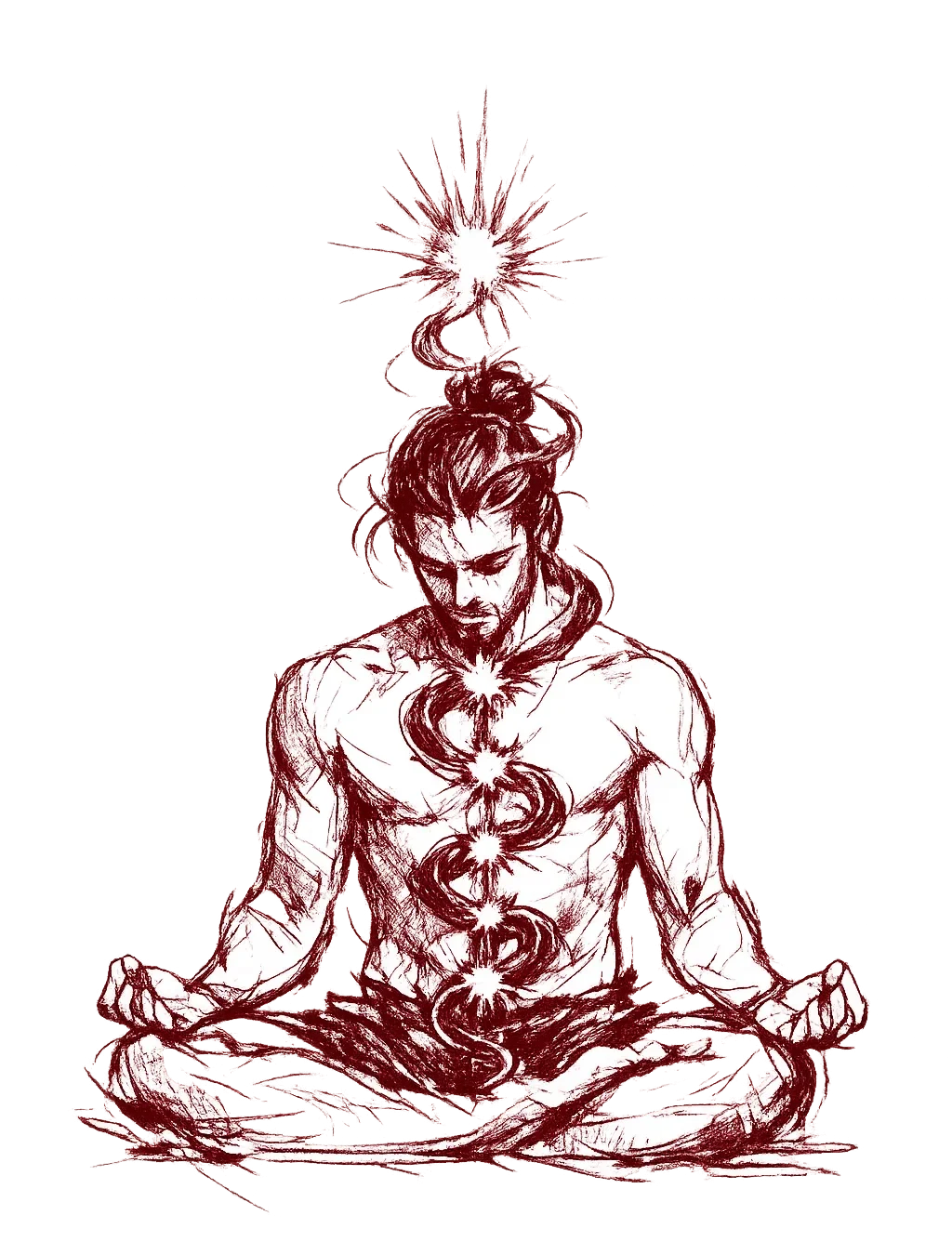
This energy sustains biological processes, emotional experience, and states of awareness. It contains intelligence and memory. Within it reside psychological imprints, unresolved emotions, and deeply stored patterns that shape perception and behavior. In certain Tantric traditions, Kundalini also carries karmic impressions accumulated across incarnations.
An awakening of Kundalini initiates transformation. The process reveals stored tension, activates dormant capacities, and accelerates inner development. For this reason, the movement of this force requires preparation, grounding, and discernment.
The concept of Kundalini originates in the Tantric philosophical systems of India. Later yogic traditions integrated it into structured practices, yet its roots remain Tantric in essence.
S: What does Kundalini mean literally?
T: The word comes from Sanskrit.
Kundalinī (कुण्डलिनी) derives from kundala (कुण्डल), meaning “coiled,” “circular,” or “spiral.” The literal translation is “the coiled one.”
The term symbolizes energy resting in a spiral form at the base of the spine, often depicted as a serpent. The serpent represents potential power, transformation, and awakened awareness. The image communicates dormant vitality preparing for ascent.
S: I have heard about physio-kundalini syndrome. What is it?
T: The term “physio-kundalini syndrome” describes a range of physical and psychological manifestations that may arise during intense energetic activation. These experiences can include sensations of heat, spontaneous movements, tremors, emotional surges, pressure along the spine, altered perception, and fluctuations in sleep patterns.
Traditional frameworks interpret these phenomena as energetic movement through the subtle channels of the body. Contemporary perspectives often associate them with activation and dysregulation of the autonomic nervous system.
Integration determines the quality of the process. Gradual development, emotional maturity, and somatic stability allow Kundalini to unfold in a coherent and embodied manner. In this state, awakening becomes evolutionary, structured, and sustainable.